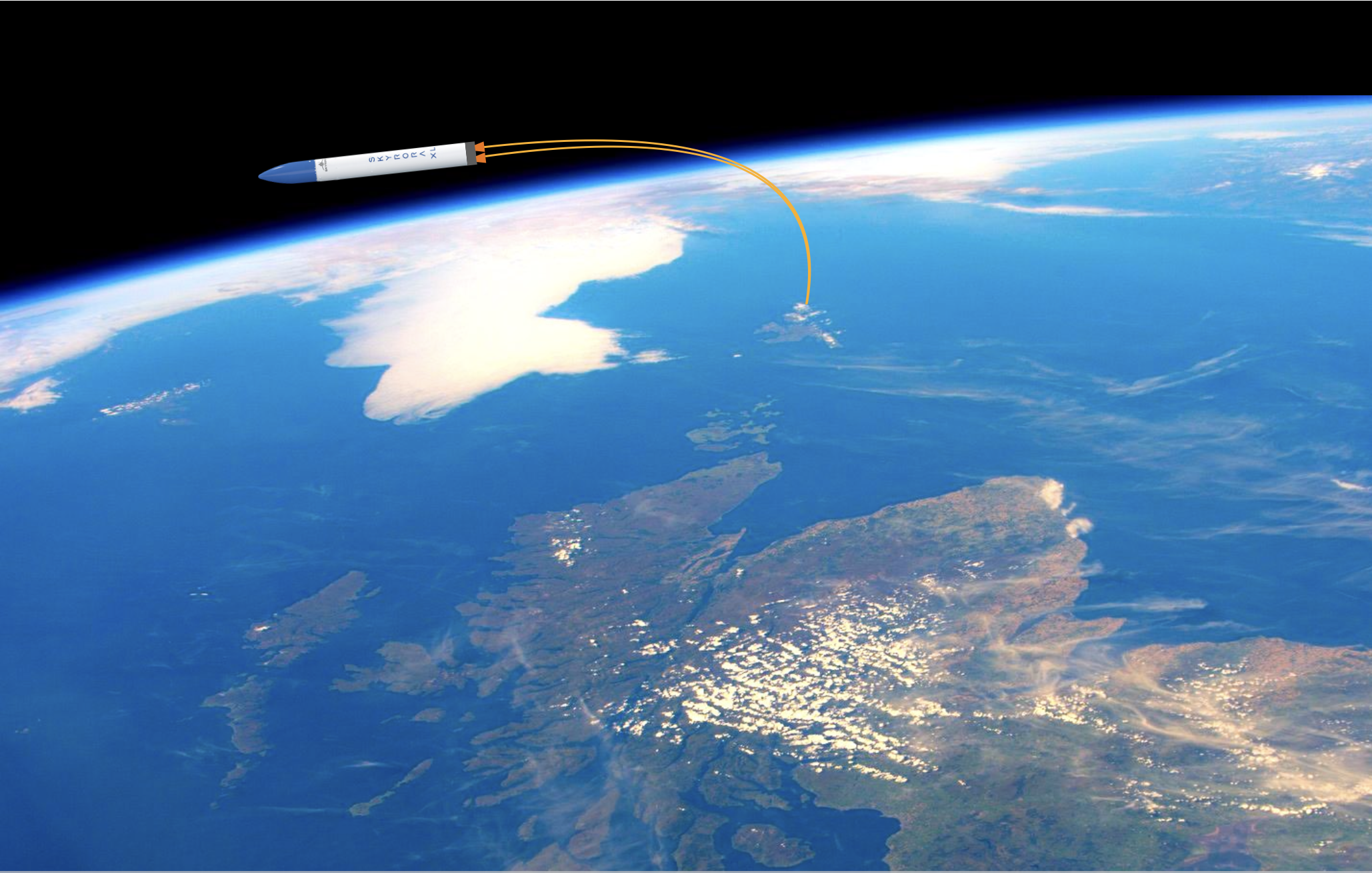
Background image credit: Commander Jeff Williams, NASA ; overlay: Gideon Cable, 2026
With ambitions to grow from 7,000 to 20,000 employees, and a sector that generates hundreds of millions for the economy, the Scottish space industry offers an exciting career path for more than just rocket scientists.
This year the first launch of a satellite from the UK will happen in Scotland. On a launch vehicle built in Scotland. Carrying a satellite designed and manufactured in Scotland. And it will be operated from Scotland.
“Scotland is quite unique in having an end-to-end value chain for space”, says Becky Ball, Special Projects Delivery Manager for Space Scotland, the umbrella organisation for Scottish space activity across academia, government and industry.
“Hopefully, we’ll have a successful launch this year, and it will complete the value chain.”
Reaching full sovereign mission capability is expected to see a surge in commercial activity across research, manufacturing and data analysis, according to Scottish Development International (SDI), the trade and inward investment agency. Scotland’s space sector generated £381 million in income and contributed £880 million to the economy in 2024, according to the Scottish Government, and is on target to take a £4 billion share of the global space market by 2040.
The sector currently employees around 7,000 people in Scotland. Despite being 5% of the UK population, Scotland is home to 16% of the UK’s space workforce, and has ambitions to grow to more than 20,000 employees in the next few years.
Scotland’s space industry is booming and needs people – and not just engineers; and not just graduates.
Getting into the Industry
“When I was a kid, I loved looking up at the stars. I was obsessed with space. I couldn’t see any career except being an astronaut and it felt really far out of reach”, explains Ms. Ball.
“But, space is changing and we need everyone. We’re needing to think about policy, law, insurance, marketing, life sciences, data analysis, economics, programming…all manner of creativity.”
“We love our engineers, but there’s a lot more going on!”
Ms. Ball is keen to point out it’s not just for graduates and PhDs. All types of skills and learning are going to be required to build and support the growing space economy.
“If you’re passionate about space, there’s a place for you in the industry.”
The Scottish space community is still relatively small. Which is a good thing and a bad thing.
Being small means that you get to have a large impact when you’re involved. You can understand how the whole system works and can easily talk to people throughout the industry, to work on solutions and find opportunities.
But, being small means it can be difficult to find a way in to begin with.
Ms. Ball acknowledges it can be daunting to start: “It can feel a bit intimidating to go to events and meet people”
She recommends following key people and organisations in the industry on social media to hear about events and opportuntities. There are many forums, networks and groups online where information and enthusiasm can be found. Specific sponsorship opportunities and specific job boards are available, some of which are listed at the end of this article.
“The key thing is to talk to people. It’s a lovely community and once you go to a few, and see the same people, you realise how small a world it is.”
Scotland in Space
Small is Beautiful
The growth in the Scottish space industry grew from advances in minaturisation. Small satellites, known as CubeSats, are at the heart of the industry. These units a massively smaller than previous satellites that could be the size of fridges or even buses.
The first Scottish CubeSat, UKube-1, launched in 2014. It measured 30x10x10 cm and weighted only 3.5 Kg. It carried 6 payloads ranging from optical cameras to educational projects.
Today, Glasgow manufactures 40% of all satellites made in Europe. The majority are CubeSats but there are a growing number of even smaller devices being designed and manufactured called PocketQubes that are 5x5x5 cm and weight around 250 g.
CubeSats are designed to undertake a myraid of missions ranging from earth observations and communications through to navigation and life-sciences experiments. They offer a commercially viable option for academics and businesses to explore the possibilities of low gravity and a higher perspective on Earth.
There are also plans for other vehicles and platforms beyond satellites. Skyrora is developing a compact Space Tug, a highly manouverable remotely operated vehicle, deliveable via the Skyrora XL, that can be used for satellite retrieval, repair and positioning, as well as being used for tackling space junk. Others are looking into low earth orbit manufacturing facilities for components and drugs, which has a special challenge of finding ways to return the products to earth safely.
These are exciting times in space.
Launch Vehicles
Up until now, satellites built in Scotland have been launched by a variety of rockets from other countries. The European Space Agency has delivered satellites into orbit using the Ariane system from French Guyana. SpaceX and NASA have launched satellites from the USA. These are large and expensive rocket systems that deliver dozens of satellites at a time.
The rocket industry in Scotland is designing and manufacturing much smaller rocket systems using innovative manufacturing techniques. Skyrora, based in Glasgow, and Orbex, based in Forres, are at the forefront of aerospace manufacturing. They both use massive 3D printers to manufacture components of their rocket engines, inclduing extreme high temperature components. They both are use carbon fibre composites for the majority of the main structures and tanks. And, they are both developing low-carbon fuels.
Both systems are containerised and can be delivered to launch sites using trucks and standard infrastructure.
These systems are smaller, easier to deploy, less costly, and much more environmentally friendly than older solutions.
It also means they are capable of being launched from Scotland.
Spaceports
A vital part of the sovereign value-chain is having somewhere to launch from within the country.
Scotland has 5 of the UK’s 7 spaceports. SaxaVord, in the north of Shetland, and Spaceport 1, on North Uist, offer the only vertical ground launch capability in the UK. Both of these sites are suitable for the Skyrora and Orbex launch systems.
It is anticipated that one of these companies will achieve a launch in 2026 from SaxaVord.
A Viable Career for Young People
Ms. Ball herself is only 22. A mathematician by training, she has always worked towards being in the industry. In her role at Space Scotland she is writing strategies, running industry round tables, and organising projects across the spectrum of the space community.
“Imagine you could work in this industry, where you’re actually launching things from Earth and you can have a tangible impact. That was what drew me in. And I think a lot of people in space feel similarly. It’s just something they’re so passionate about and that you feel quite lucky and fortunate to be able to work in such an interesting industry.”
“Space isn’t going anywhere. The industry is growing massively. You’re not going to be out of a job.”
“Why wouldn’t you want to work in space?”
Links to space related opportunites
- https://spacescotland.org/
- Skills for Space UK Space Agency Internships Programme – GOV-UK Find a grant
- Scotland’s space industry opportunities and space capabilities
- https://spaceuniversitiesnetwork.ac.uk/marsyard2026/
- https://spacecareers.uk/home
- https://prosperofellowship.org/
- Mentioned companies


