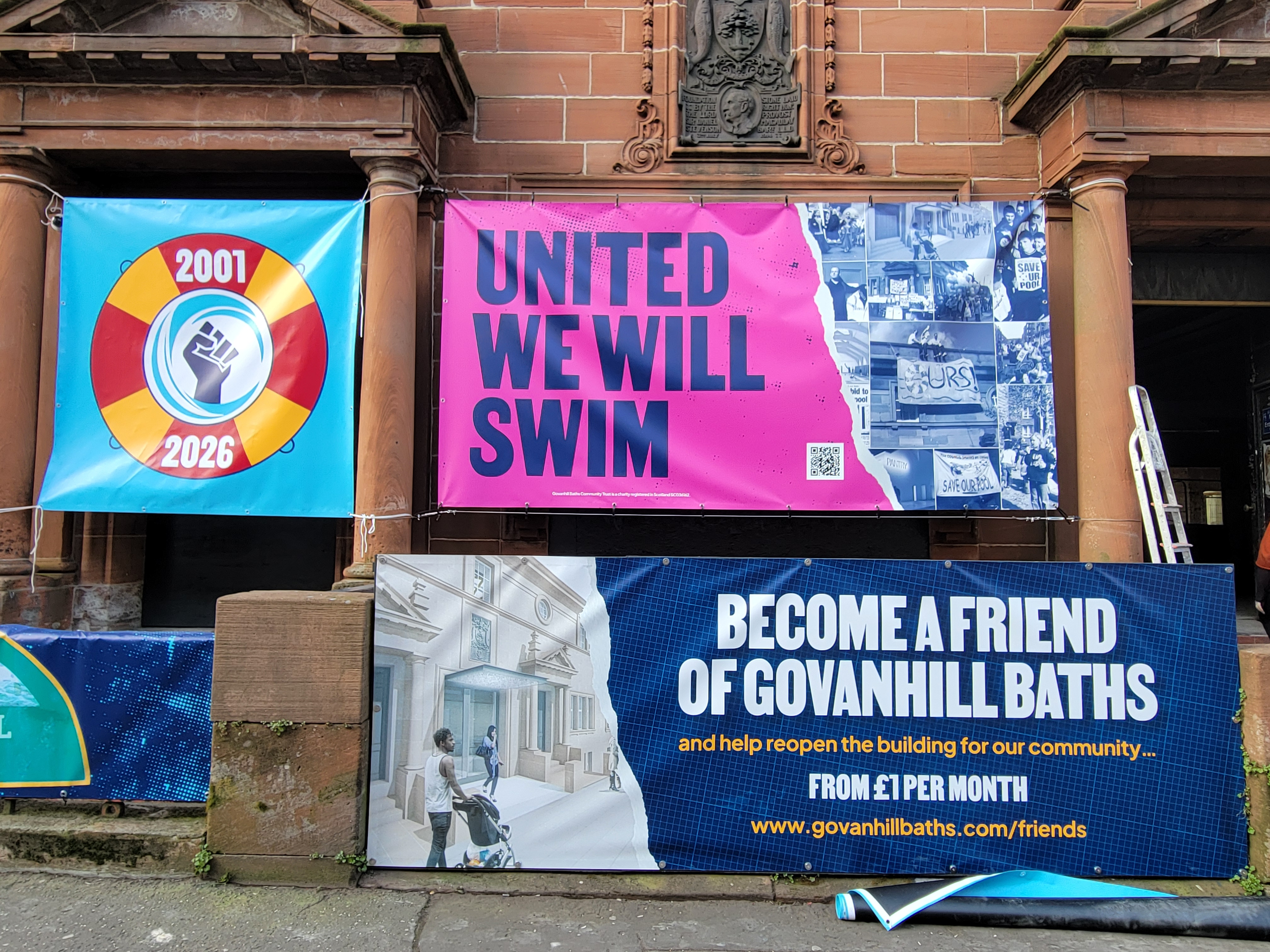
On March 21, 2001, a group of women from Govanhill were enjoying what could have been their last swim in their local pool. But instead of getting dressed and leaving as normal, they chained themselves to the lockers, an act of protest against Glasgow City Council’s imminent closure of their beloved pool. Although they may not have realised it at the time, they had just kickstarted the longest occupation of a civic building in British history.
On a Saturday evening 25 years later, about a hundred people gathered in front of the Govanhill Baths as brass music boomed throughout the block. Volunteers in yellow tops which read “SAVE OUR POOL” struggled to contain the crowd on the narrow sidewalk as Calder Street’s traffic passed by, with many of the vehicles honking in support. It was one of the first sunny days after Glasgow’s long winter months, and the weather couldn’t have been better to celebrate the historic occasion.
2026 marks 25 years since the people of Govanhill occupied their local pool in protest of the council’s decision to close it. As a result of 140 days of occupation, the pool fell into community ownership managed by the Govanhill Baths Community Trust (GBCT), who plan to reopen the baths as a leisure and wellness facility for the local community.
“That building was built for the people of Govanhill and we’ve saved that heritage,” said Alex Wilde, chair of GBCT. “We’ve been proud to be able to show people around, show people where we’ve got to with that building.”
The inside look
Before the celebration kicked off, I met Katherine Mackinnon in front of 99 Calder Street for a tour inside the Govanhill Baths building, which is still under renovation. Mackinnon is one of the people behind Radical Glasgow Tours, who were asked by the GBCT to lead tours of the building for the 25th anniversary. Due to insurance constraints, only a dozen or so people can go inside at a time, so spots on the tours were limited. Many people who showed up on the day hoping for a look inside left disappointed.
At the beginning of the tour, Mackinnon asked everyone to describe their connection to the baths. While some people, like me, were new to Glasgow and had only recently learned of this site of struggle, many shared fond memories of the baths and the occupation.
As we walked through the building, it’s clear that renovations are far from over. The floor is uneven, panels are missing from the walls, and some areas are fenced off. But as we entered each room, the eyes of several of my tour companions lit up as their memories of the baths and the occupation came back to them. For several people, this was where they had first learnt to swim. Another recalled participating in the occupation itself, claiming he spent three nights standing guard alone in the building.


For Alice Lister, Govanhill Baths hold particularly special memories. Her mother lived just around the corner on Albert Street, and growing up, she would come to the pool after school for swimming lessons then head to The Unique chippy on Allison Street. Many years later, an old friend mentioned attending a wedding at the baths, and she knew it was the perfect place to tie the knot with her now-husband, Alex Belcher.
“We came and we spoke to Jim and Bruce, who were the custodians at the time, and it was all very casual, you know. I think it was like a couple of hundred pounds.” she recalled. “There’d been someone getting married the week before, so there was bunting and everything hanging out.”


Mackinnon led us to a foyer with an archival display of physical artefacts from the days of the occupation. This includes newspaper clippings, protest posters, photos, and “Southside Against Closure” banners. There was even a roster for pickets, and Mackinnon pointed out the name of Helen Kyle, who fought to save the Kinning Park Complex from closure in 1996 and offered guidance to the community in Govanhill. This, she argued, shows the interconnection between the various struggles for community spaces in Glasgow over the past few decades.


25 years too long
Although Govanhill Baths haven’t been open for swimming since 2001, the GBCT has been hard at work organising arts, wellness, and skills training opportunities for the local community. The Govanhill Festival each summer celebrates anti-racist solidarity, “Rags to riches” workshops teach practical upcycling skills, and several archival projects exist to preserve the rich working-class and immigrant histories of the neighbourhood.
However, Wilde acknowledged that 25 years is too long to go without a pool.
“We need to be back in that building. We’re not where we thought we’d be,” she said. “We’re working together really hard with the funders, partners, and supporters to hold on to the vision that we have for that building and the ambition that we have for that building and mobilise a plan of action.”
The main obstacle has been securing funding for the significant renovations needed to make the pool operational again. Wilde recalled that when they first started construction in 2021, they thought it would be done in two years. Unfortunately, she said that events such as the COVID-19 pandemic, the war in Ukraine, and the cost of living crisis have affected the capital project.
The anniversary celebration launched Friends of Govanhill Baths, a membership scheme where people can get insider updates and participate in running GBCT starting from £1/month.
“We’ve always been a creative campaign and we will get the community back in that building,” Wilde said. “Our ambition remains for it to be a welcoming, beautiful, accessible building that provides opportunities for sport, exercise, creativity, socialising, relaxing, and celebrating the wonderful community that we have here.”
Lister appreciates how the baths have served as a community space, but agreed that the goal is swimming again.
“I think that there’s something nice about the fact that because it’s owned by the trust, that all of these ideas for the different functions that it’s going to have are looking back to what’s been important to the community in the past,” she said. “It just has a real place here in Govanhill.”

Govanhill is one of the most ethnically diverse neighbourhoods in Scotland, and contained some of the top 5 percent most deprived areas on the Scottish Index of Multiple Deprivation in 2020. The GBCT plans to make the baths accessible and affordable to lower-income community members by offering lower prices than other local leisure providers and ensuring that people can hang out in the front suite without spending money.
“The community deserves a wellbeing facility to tackle some of the inequalities, some of the health inequalities in this area,” said Wilde.
Celebrating collective action
After the tour ended, we left the building to join the celebrations that had kicked off outside. It was hard not to sway to the infectious rhythm from the drums of Brazilian carnival group Bloco Dandara, accompanied by circus performers. Pride and Romani flags waved from the tents where volunteers handed out flyers to stay updated with the campaign.
But the most memorable moment happened at the end of the night, when the original picketers from 2001 took the stage singing picket songs to the tune of classic songs such as “A Nation Once Again” and “This Land is My Land.”


For Lister, the celebration was about honouring the occupation’s enduring legacy.
“[It’s about] remembering the impact that people had when they occupied the building, that it made an actual difference, that you can make a difference in collective action, and that’s still relevant now even though this was 25 years ago,” she said.
Wilde hopes that the celebration will help to maintain the visibility of the campaign as they apply for funding from the UK and Scottish governments.
“What we’re asking of you today is to shout loud for what the baths mean to you,” she told the crowd. “Tell your elected representatives, tell your neighbours, tell the visitors to our city when the Commonwealth Games come.”


