
The global food system is under increasing strain from climate change, ecological degradation and geopolitical instability. With intensive farming struggling to adapt, residents in Leith are taking matters into their own hands and turning to community-led food growing as a more sustainable and resilient alternative.
“Think global, act local” – David Brower, Friends of the Earth.
This is the mantra of many environmentalists. It calls for a stoic response to the mounting environmental threats facing people and nature. It is these words that are used to encourage people to stand up and act in the face of prevailing injustices.
However, the weight of these words can only be felt if you’re aware of the movements and initiatives that embody them; the movements that oppose the status quo and prove that things can be done differently.
One such initiative can be found right here in Edinburgh. The charity Earth in Common, which is located on Leith Links, was founded with the radical ambition to tackle climate change, address social injustice and fight back against a broken food system.
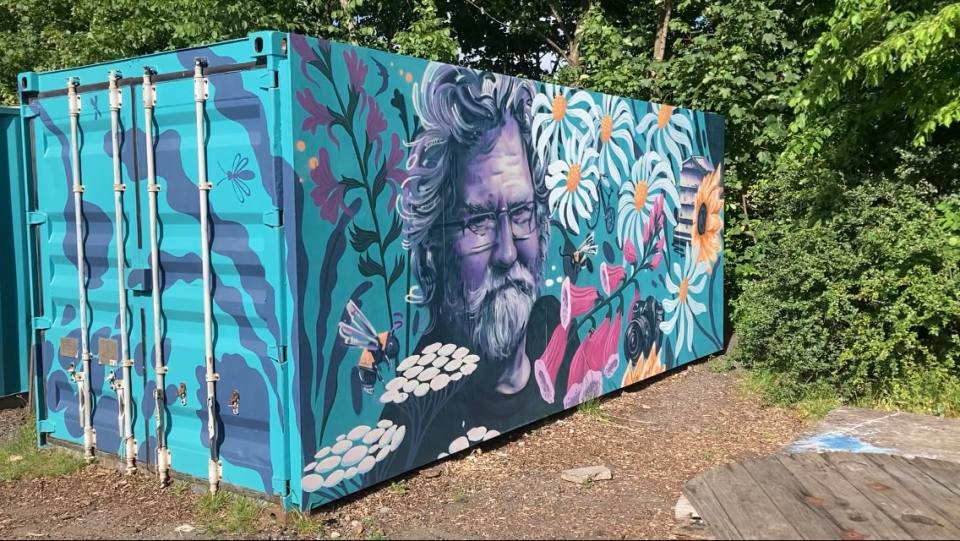
Mural of community member, David Morrison, at Earth in Common. Credit: Hugh Wilkinson
In line with the above mantra, the project is grounded in the belief that global issues must first be addressed by acting locally.
The CEO, Evie Murray, explained how Earth in Common has aimed to do this:
“The motivation behind the movement was around growing free food everywhere and to take control of our food system. But also, to have the community that live here be more involved in how their food is produced, know where the food comes from and understand its impact.”
This idea of regaining control of the food system for people is known as food sovereignty. It originates from the belief that people have a right to healthy food that’s been produced in an ecologically sound and sustainable way. It also centres the right of people to define their own food and agriculture systems.
One of the main aims of Earth in Common is to promote this idea of food sovereignty. Their reasoning behind the need for food sovereignty is based on the inadequacy of the current food system. Ms Murray explained how the supermarket model was harming the environment and farmers and why change was needed.
“The supermarkets have a very extractive model. They extract wealth out of communities, they extract all the goodness out of the environment, and they put so much pressure on farmers and people who are farming in an environmentally sound way. Over the last 20 years, these farms have not fared well and quite a lot have fallen away under the pressure of the supermarkets”, she said.
The view that the food system is too “extractive” is now becoming more broadly accepted outside of environmental groups. For many researchers, it is becoming clearer and clearer that the for-profit model is responsible for the vulnerability of the food system.
Elise Wach, a researcher in food security at the Institute of Development, explained how these harms have manifested in Scotland:
“The production on arable land, currently in Scotland, is highly intensive and catastrophic for soils. The practices employed use a lot of chemicals and tend to degrade soils rather than rebuild them. This is really catastrophic for water and air pollution. It’s this arable production that is really degrading the very resource on which it depends”.
Ms Wach added that farming needs to be done on a “more human scale” and advocated for methods like crofting.
“Scotland could produce much more, if not all of its veg and fruit, not just using the arable land, but using what is currently considered a lot of upland farming area. Some of the soils are amazing. A lot of it has been degraded by intensive sheep farming, but soil is a living entity that can be degraded and that can be rebuilt”, she said.
Earth in Common’s Urban Croft Model

Earth in Common’s Urban Croft. Credit: Hugh Wilkinson
Recognising the value of Scotland’s crofting tradition and the need for smaller scale production, Earth in Common has adopted a modern version of the traditional croft to promote sustainable, community-led food production. Using a small plot of land, the urban croft provides healthy foods to residents and aims to build connections between the community and the land.
Kara Moore, a Leith resident and volunteer at the project, commented on how the project has benefited her.
“I like volunteering at the croft because I get to go and enjoy my time outside while talking to like-minded others from around the area. It’s important for me to feel a part of a community that is doing good things for the right reasons”, she said.
The success of the croft in bringing together the community and providing a sustainable alternative has captured the attention of many around Scotland. Similar initiatives are now being replicated across the country. Despite the surge, Evie Murray wants even more communities to create their own urban crofts.
“We look at this as a model that could be replicated. There is lots of organisations doing the same thing. I think that there’s no reason why we couldn’t have little Crofts all over Scotland. We would love to see other communities learning from what we’ve done and be able to do it in all sorts of places”, she said.
To learn more about Earth in Common and find out how you can get involved, click on the link: Earth in Common | Environmental Charity | Scotland


