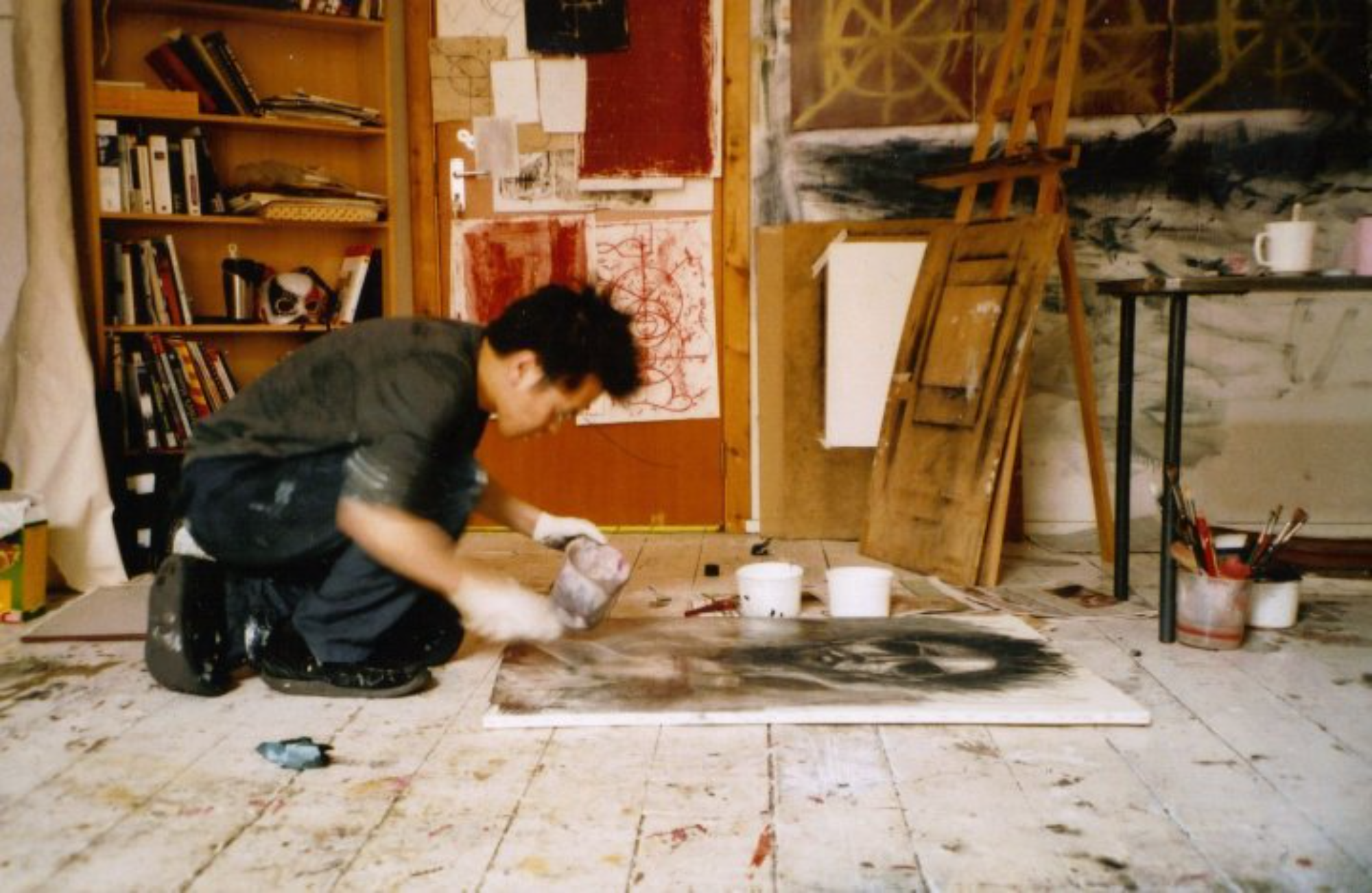
Born in Falkirk in 1982, Frank To is a Scottish artist, whose journey from a challenging upbringing to national and international recognition has been shaped by innovation and persistence. From early sell out exhibitions to his signature gunpowder technique, Frank’s work channels unstable materials into striking artwork, while his career displays his commitment to navigate the art world on his own terms.
At a glance
Frank To is a Scottish artist, who has become renowned for his gunpowder technique.
His work is shown alongside internationally recognised artists such as Jimmy Choo, Damien Hirst, Francis Bacon, Banksy, Antony Gormley, Andy Warhol and Grayson Perry.
Frank is now programme lead and lecturer in Contemporary Art Practice at UHI Inverness, hoping to leave behind a legacy.
For Frank, being an artist was always the only option for him.
Frank said: “I’ve always stuck to the story that I didn’t choose art, art chose me.
“I know that sounds a bit … magical”, he laughs.
However, Frank highlighted that he faced immense pressure to pursue a more traditional career, by a parent with the best intentions. Despite this, Frank always knew what he was destined to do.
“I suppose this was the case for any child growing up in the nineties, I was forced by my mum to take subjects that would give me a career and help me make money.
“When I told my mum it was art that I was going to do she absolutely hit the roof.
“But, ultimately, that was what I was set on.”
Frank’s journey can be characterised by this early interaction, where he followed his dream despite the adversity that he faced, making it a story worth telling.
Click through the dots below to see some early photos of Frank!
Upbringing
Frank was born in Falkirk, before moving to Glasgow at a young age.
He credits his mum for his hard work ethic, as she juggled raising three children while successfully running her own business.
Frank highlights that having a split family was extremely difficult, and majorly influenced his decision to move away when choosing where to study after school.
“I grew up in a dysfunctional family, it was quite a difficult upbringing I was raised in. Also being raised by my mum who had to work quite a lot to support three kids, I suppose I just wanted to get the hell out.” Frank states
Frank recalls choosing Huddersfield University, and assuming it was next to Murrayfield, Edinburgh until he was on the train for his interview.

However, despite not initially planning to go so far, he credits a lot of his success to the teaching he got when at university.
“One thing I’m really grateful for about going down to Huddersfield for my art was that I got taught by lectures who were actually artists.” Frank added.
“I got taught in a really, in your face, work industry, ‘this is how it is and if your not going to do this your not going to survive’, but I was really lucky because the way I was taught set me up really really early on.”
After graduating, Frank completed his Masters at Duncan of Jordanstone College of Art and Design, and was the youngest person in his masters.
When Frank completed his education, he was only 23-years-old.
Gunpowder technique
After graduating Frank moved from his traditional oil painting, to the gunpowder technique, a decision which he explains below.
Frank has become known for his gunpowder technique.
Gunpowder art is a contemporary art form where artists use ignited gunpowder as a medium, creating unique and often explosive drawings by arranging the powder on surfaces like paper or canvas and setting it off.
The method uses controlled detonations, sometimes with stencils or chemicals, to create spontaneous patterns.
The gunpowder technique is known for its ability to transform destructive potential into images of life, nature or abstract forms.
The explosions create marks and textures, notably fine lines and scorched patterns, forming artwork that is often unpredictable and powerful.
Click on the cards to see some facts about the gunpowder technique
One of the first galleries that took Frank’s work in was ScotlandArt.com, who were the first gallery in Scotland that did online purchasing.
Here is an example of one of Frank’s gunpowder pieces.
Success
Frank got his first exhibition there when he was only 19-years-old, but got his first “Big London Exhibition” at 23-years-old.
“I got my ‘lucky break’, if you could call it a ‘lucky break’ as such when I was in art school.
“I wrote to about 500 galleries to try and get an exhibition. This was before digital submissions so I had to take slides of my work, I must’ve spent a fortune that year.” Frank laughs.
“Out of that 500, 10 got back to me, and 2 said yes. So out of the 500, only 2 said yes, but it meant that I got discovered quite early on.”
On the first night that Frank’s work was shown in the exhibition he sold out all his pieces.
Frank told me how that felt, highlighting that for a young 23-year-old “that was an absolutely massive deal”.
Since these early exhibitions, Frank has had many more exhibitions.
Check below!
Frank highlighted that despite his success, he did have to put in the work to get him to where he is now.
“It was a difficult period because I was a young emerging artist in the noughties and we had that couple years under the Blair regime and then the recession happened.
“So that was when I had to be a little bit smart.
“Thanks to my mother, who is quite business savvy, it meant that I learnt how to be business savvy, and one thing I learnt was that you need to survive on your own terms.
“With the recession I had to be really focused on marketing and PR, and when I was having exhibitions I had to make sure that I was selling.”
“I think a lot of my reputation was to do with the resilience I showed. I survived the recession, Brexit, and even the pandemic as an artist. That’s because of my persistence.”
Frank has many high-profile collectors, including Star Trek actor Sir Patrick Stewart.
I spoke to Elizabeth Thom, who collects Frank’s artwork.
She recalled the moment that she first discovered Frank’s work:
“I first came across Frank by accident. I was waiting for my partner to park in the shopping centre in Inverness, when I spied a painting of a blue tit in a gallery window. I knew I had to own it.
Check out Frank’s social media, clicking the buttons below!
Legacy
Frank believes that his legacy is made through what he passes onto young Scottish artists.
Besides teaching, Frank highlights that many younger artists look up to him as an artist because of the success and advice he can provide.
Frank was self assured even as a young artist, a trait he remembers annoying a lot of artists at the time.
“I always knew where I belonged and stood in the arts.
“Being a young whippersnapper in the noughties I definitely pissed off a lot of the established big dogs.” Frank recalls.
“But, I do wish I had someone like me to look up to, and to help, that would’ve meant so much to me.”
One of Frank’s students, Katie Humphrey, spoke about the legacy that Frank is leaving on his students.
“Throughout my time as a student with Frank, he was a consistent source of encouragement and support. His teaching didn’t just help me at the time, it’s something I still draw on now in my work as an independent artist.
“Now that I’m studying to become a lecturer in the same field, I appreciate even more how thoughtful and generous his approach to teaching was and how much it has influenced the way I think about education.”
Another student, Codie Anne, expressed the inspiration that Frank provided through his own work.
“As a teacher, Frank was honest with us about his successes but also failures, that way we understood the challenges we may face.
“Seeing him constantly push himself to explore new materials like his humanuim metal work inspires me. I feel incredibly lucky to have been taught by Frank To.”
It’s clear that Frank’s desire to leave a legacy within the art world reflects within his teaching and impacts the students that he meets.
Although Frank has lived a very successful career, he emphasises to me that “he’s not done yet”, and with Frank’s passion, something tells me whatever he decides to know next, he will do it well.
Here is a summary timeline of Frank’s journey as an artist, to where he is now!
-
-
1982: Frank is born in Falkirk, before moving to Glasgow.
-
-
-
2004: Frank completes his BA (Hons) Fine Art at the University of Huddersfield, establishing a solid technical and conceptual foundation.
-
-
-
2005: Frank returns to Scotland to undertake an MFA at Duncan of Jordanstone College of Art & Design, Dundee. Frank’s work is acquired by prominent collectors, including Sir Patrick Stewart.
-
-
-
2005: Before graduation, Frank gains a celebrity following in his work and starts exhibiting in London which in his first showing, all his Masters Degree work sold out. He uses this success to apply for funding to become a self-employed contemporary artist.
-
-
-
2011: Getting a breakthrough viral exhibition using the Plague Doctors. This gives Frank international recognition.
-
-
-
2019: Frank produces significant socially engaged works, including pieces using Humanium metal made from decommissioned firearms.
-
-
-
2020: Frank takes on academic roles, becoming Programme Lead and Lecturer in Contemporary Art Practice at UHI Inverness.
-
-
-
Present Day: Frank serves as Co-President of the Society of Scottish Artists and elected member of the Society of Graphic Fine Art.
-


