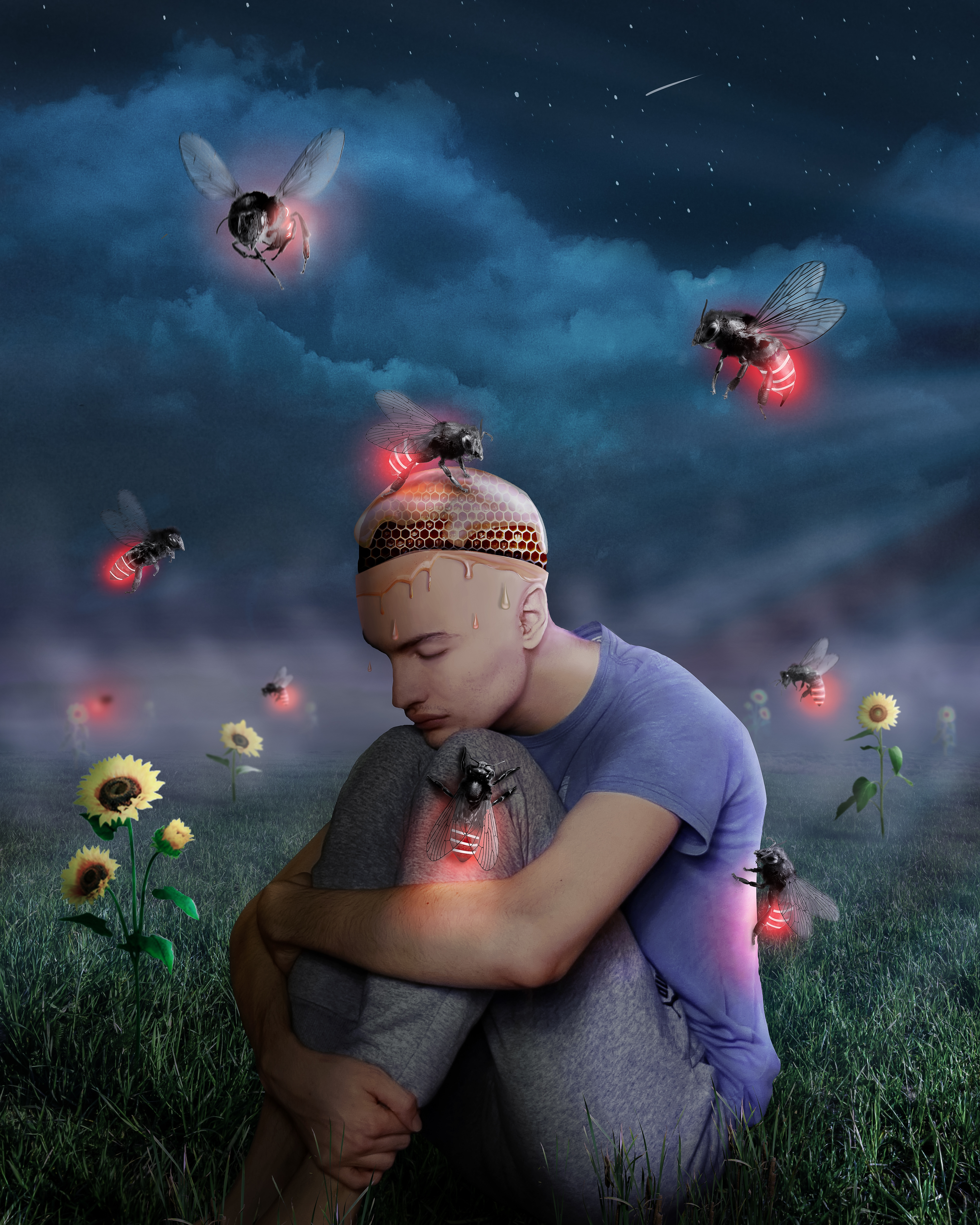
Depression. You wake up; the world outside of dreams is overwhelming, and the reality of the day ahead weighs you down. You close your eyes again and ask yourself, “Why do I feel this way?”
“There wasn’t anything in particular. I was mostly just fighting off my own inner demons,” says 26-year-old Donald, a graphic design student from Greenock. Talented, chatty, and full of energy, popular among his peers. But just a few years ago, he stood at the bridge with eyes firmly fixed on the calm surface of the river Clyde, sending his last goodbye over a text message.
Depression creeps in on you: the low moods, and struggle to find the positive side of life. Hopelessness. Suddenly, you find yourself fighting waves of suicidal thoughts. “There’re countless times that I’ve planned all these other wee schemes that would end my life,” he says.
For Donald, “this has been a long seven, eight years of constant ups and downs.” In moments of clarity, he mastered courage and asked for help, hoping to be referred to a specialist. “Maybe you should just try and have happier thoughts,” he heard from his GP.
According to Paul Sweeney, the Scottish Labour spokesperson for mental health: “The mantra is: ‘Don’t come and see us until you’re sick enough to justify coming to see us, and then we’ll treat you.’ It’s a very old-fashioned system. “They’re not recognising that just letting people spiral into a worse situation is counterproductive.”

The second time Donald asked for help; the counsellor told him that there are people out there who are “a lot worse off” than he is. “Be grateful,” he said. Grateful that his dad, who was diagnosed with MS, is “still here.” Grateful for having “a job.” “I was so enraged; I was enraged that she had basically just said that I’ve not really got a reason to be the way,” says Donald.
With time, his depression deepened. The loneliness and separation brought on by COVID–19
distancing rules had its effect too. In early 2021, a supposed fun night out in Glasgow turned into a lonely walk through deserted streets. “A dead set,” as Donald describes it.
“This is it, I am going to do it,” he thought to himself as he walked towards the river Clyde; “dramatically crying.” “If I’d had support early on,” reflects Donald, “I probably would have matured quicker emotionally to deal with stuff, and I probably would never have ever gone to the stage that I went to, because in a way, it was almost a cry for help.”
According to Sweeney: “The first thing we can do is try and normalise that and take the stigma away” and “educating people about the support that’s around.” As Donald says himself: “Mental health is quite taboo at the moment, especially men, which I think was another reason I found it so hard, is because men don’t show that kind of emotion.”
Asked why he tried to take his own life, he answered: “I felt like there was no other avenues I could explore in my head.”

Through numerous challenges, Donald matured, gaining insight into himself and identifying the root of his depression. “It’s only recently that I’ve realised it could have been something to do with the fact that I was dealing with my sexuality. “In my head, I wasn’t gay,” he explains. “I was really, really in denial for years, years, years.”
Donald might understand it now, but that night at the bridge he felt differently: “I made my
peace, put my phone down.” As he was walking away determined to end his suffering, a man shouted after him. Bobby. Homeless Irish. An addict. A guardian angel who saved Donald’s life.
The demons of that night dissolved as they shared life stories. “It was almost for me like counselling, because this was someone that I knew that I was never going to see again.” “I like Bobby,” he says. “It was the longest time that I hadn’t been depressed after that. “And then it all came back.”
A few months later, around his birthday, Donald woke up on the floor of his bathroom. The scar on his arm is a reminder. Terrified, he texted his mom. On the inside silently screaming for help: ‘I want to live’. In no time his mother was by his side. “She saw my arm; she gave me a hug,” Donald recalls.

His scream for help had finally been answered. From now on the Crisis team and SAMH charity supported Donald, and looked after him as he was recovering. “I basically had to build a whole new person up again because I completely broke emotionally, mentally, physically, everything.”
As Paul Sweeney says, mental health is “a complex area to deal with”. Household finances, precarious work, and a sense of social exclusion, maybe a sense of toxic masculinity are among the root cause problems that cause stress in people’s lives. To some extent, it goes down to money.
Dr Jim Crabb, of the Royal College of Psychiatrists, told the Guardian: “Despite serious illnesses such as schizophrenia, depression, and anxiety costing economically developed societies more than conditions such as asthma and arthritis, far less is spent on mental health compared to physical healthcare.
Despite the Scottish Government’s pledge in its NHS recovery plan to allocate 10% of the total frontline NHS budget to mental health, this year’s mental health budget saw a £30 million cut. “Not only are we still failing to meet that, we’re already 180 million pounds a year adrift of the target,” says Paul Sweeney.
Is the system failing people suffering from depression? What more needs to be done? Donald’s story ends well. He completed his course and will continue his education at the undergraduate level. Though he still experiences low days, he now knows where to seek support.
According to Sweeney: “Pretty much everyone will have to deal with a mental health crisis in their lives. And it’s just about how we improve our resilience and our openness about talking about it and supporting each other.


One Comment