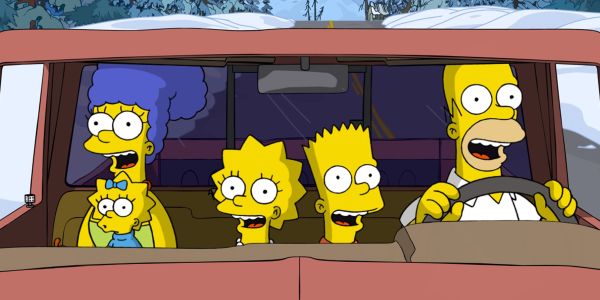
With the new movie set to hit theatres in 2027, the legendary cartoon is in danger of becoming a dead horse beaten to a pulp. I sat down with five tentative fans to discuss the legacy of The Simpsons and whether it could ever really return to form in the freakish landscape of today.
The year is 2025 and the movie that everyone’s been waiting for for 18 years has finally been announced–except, no one was really waiting for it and, though there’s some cautious optimism among fans, a great many think it’s time to call it quits. “It means a lot to me, but it’s really a shame to see what it’s become,” laments Catriona, a long-time fan who was lucky enough to be sentient during the show’s “golden age” in the 90s. There seems to be some consensus that the first movie, which corralled together many of The Simpson’s most prolific early writers, was an improvement on the show at the time. Could they do it again? “I’m not sure they’ll be able to improve it more than it is now,” continued Catriona, losing grasp of her optimism, “and if they do, is it really worth it? I think maybe they just need to let it rest in peace.”
Since the 2007 film’s release, a lot has changed. Phil Harman is dead (Troy McCLure, Lionel Hutz), Russi Taylor is dead (Üter Zörker, Martin Prince), co-creator Sam Simon is also dead, the voice of Lisa Simpson, Yeardley Smith has retired, Apu has been retired, Trump’s the president (again) – oh, and legacy-media-conquistador, Walt Disney are are at the helm. “It just seems like Disney’s whole M.O. at this point is to latch onto existing properties that they pay a fortune for and milk them dry,” says Rory, another long-time fan who refers to episodes by their full title and scoffs if you don’t remember who Angry Audience Member from Season 5 Episode 1 is. But why release the film now? “Film releases are obviously planned years and years in advance,” says Rory in response, “and I imagine it was just Disney being like, ‘we want something to release during this specific slot’.” And he’s not wrong. Just prior to the film’s announcement, Disney pulled an untitled Marvel movie from its July 23rd, 2007 slot, and replaced it with yours truly. “There we go, Disney wants a summer blockbuster and if they don’t have the Marvel money, they’ve gotta’ go for The Simpsons.”
The Simpsons was perhaps the last hurrah of a television culture now deceased. With zero streaming services and all hands (family bums) on deck (the sofa), the six o’clock slot needed to have a broad appeal. “The Simpsons tried and could be as enjoyable for the parents who were sat down watching it [as for the kids],” says Toby, a sixty-something father with a strict TV curfew that only ever came into force after the show had finished. “I used to have a little side laughter ‘meself watching it – pretending I didn’t like it at all of course, because anything your children like you have to give the pretense of not liking.”
The show’s rounded production was reflected in the writer’s references and wholesale spoofs of classic movies. As a child watching, you probably didn’t know who Rhett Butler was or how he simply did not give a damn after years of pining in Clayton County, Georgia, but your parents did. Speaking of television time in a bygone era, Toby says, “It would be on a Sunday afternoon and you only have three or four channels, and the films that came on then would be the films that my parents grew up with…So even people of my generation tend to know quite a lot of films of the 40s and the 50s – you know the classic ones – I’ve seen all of them 100 times because they would come on the box again and again.” So while the parents of millennials were bonding with their parents over Walter’s naivety in Double Indemnity, or Norma Desmond’s close-up in Sunset Boulevard, we were creating our own intergenerational ties through the Simpsons family. For us, the show swallowed up every reference and spat it out in a yellow-hued, four fingered palanza of storied side characters, knowing jests and anarchic sincerity.
Although The Simpsons was partly for kids, they did not baby this section of their audience. From Homer’s flippant use of strangulation to the Itchy&Scratchy show, which probably wouldn’t make daytime TV in real life, kids responded just as strongly as adults to the lack of saccharine moralising. As noted by Lottie, a 25-year-old musician who still cries when Marge and Homer are on the rocks, they even show the couple as having quite an intimate relationship, or ‘snuggling as they call it.” And this hands-off approach regarding censorship is mirrored in the characters themselves, with the Flanders and Van Houtens often portrayed as overbearing divvies in comparison to the Simpsons. For Toby, the level of parental disinterest harkens back to an earlier era when children were left to just be children: “[The parents are] not under the thrall of their children in a way that so much modern parenting is depicted…Marge tries to ensure that they do their school work, but Homer would consider that they’re much better educated going to the football game.”
However, the kind of shared mainstream culture necessary for such broad appeal is likely impossible today. The ever battling convoy of streaming services knocks heads with a disparate internet culture that refracts more by the day, sinking efforts towards multigenerational entertainment. To make matters worse, the writers’ attempts to keep up with this freakish post-post-modern landscape often feel anachronistic and unsettling. “ I watched the odd new episode here and there,” says Rory who tends to stop short at season ten, “like the Elon Musk one and it made me want to kill myself.” 26-year-old Findlay, who corralled his younger siblings around the 6 o’clock airing when his parents lived away, has similar worries: “I feel like [the new film] is gonna lean too much into tropes, you know, try and be too modern and do TikTok jokes that won’t land with either audience.”
It is a possibility that the Simpsons belonged to a moment in time and is incapable of traversing the new hyper-referential, insular and self-satirising landscape of the 2020s. Indeed, the fact that it’s still being renewed season after season speaks to a culture stuck in time, unable to let go and often ill-equipped to address the current state of culture, politics included. “The world right now is just satire already,” says Lottie, “there’s not really much nuance you can give because the world’s so ridiculous.” In order to really take on a political figure, as the show effectively did with Clinton, Ford, Carter and Lincoln to name a few, these figures need to comport themselves with some level of subtlety and at least a veneer of sincerity. Touching on political comedy of the past, Toby remarks, “The normal way is to take their mannerisms and their gesticulations and blow them out of proportion, but how can you blow Trump out of proportion when he does it himself all the time!”
Part of The Simpsons’ schtick, and indeed the great respect it garnered from fans, was their refusal to play ball. Republicans suck, the Democrats equally suck – but for different reasons–, Abraham Lincoln is a robot mouthpiece of American mythology and the Mayor of New York is primarily a position for womanising, cash-hoarding opportunists. In the episode where Bart gets an elephant, aptly titled Bart Gets an Elephant, attendees to the DNC hold signs which read, ‘we hate life and ourselves, we can’t govern,’ while their counterparts’ at the RNC read ‘we want what’s worst for everyone, we’re just plain evil’. (It’s worth noting that prior to being trampled by the escapee elephant, the democrats cheer thinking it’s their mascot.) However times have changed, and it’s uncertain whether the film will retain this mutinous tone. “I don’t want to say the democrats are good because they’re complete fucking scumbags, but just with how openly evil the republicans have got, The Simpsons have noticeably shifted to the left,” notes Rory on the recent episodes. Following a tweet by Trump senior advisor, Jenna Ellis, in which she likened Kamala Harris’ voice to that of Marge Simpson, the writers responded with a video of Marge calling her out: “I was gonna say I’m pissed off, but I’m afraid they’d bleep it.” Ellis responded by calling the cartoon character a vote-by-mail democrat.
With the original edginess of the show in question, stunts like this also push The Simpsons into unsettling territory. “I think the drawings are too clean now, it feels a bit AI,” says Findlay, with aesthetic judgement rather than nostalgic yearning, “the spirit of Matt Groening has gone.” Similar issues arise around the simple fact that the cast are aging. Discussing his expectations for the new film, Rory says, “Its almost going to feel like there’s this uncanny valley thing with the voice actors because their voices will have changed so much – obviously some of them are fucking dead.” As always, it is the subtle destabilizing of a familiar form which disturbs the most, and if the new film can’t transport us to our childhood, this Freudian dread definitely will.
Amongst concerns over the show’s modern suitability is a reminder of perhaps its single greatest strength: its heart. While faith in institutions waver and a general sense of nihilism persists, the endurance of familial ties amidst feuds, the eternal dread of being down-and-out when rent is due, the chasm between what you value and what the world demands you be, these are as poignant today as ever. “Maybe I’m just ascribing myself a quality 25 years in the future,” says Rory, “but I feel like Lisa in particular was one where maybe it was okay to be a bit of an outsider, because I always kind of was.” And for Lottie, who lost her mum at a young age, Homer and Marge offered a formative portrait of adult love amongst the complexities of family life. “I love their relationship,” she says with grounded sincerity, “even though Homer’s such a useless husband, you can just tell how much they absolutely adore and understand one another.”
Homer’s moral failures allow for the fundamental goodness of his character to be revealed, and this holds true for the rest of the characters as well. When Lisa discovers the true villainy of town founder, Jebediah Springfield, she eschews her usual didactics in favour of a secret that maintains civilian faith. When Mr Burns uses a variety of double-dealing schemes to retrieve his childhood teddy, Bobo from Maggie, she willingly hands it over, recognising the needs of a lonely old man. During an especially hot summer, a selfish and inept Homer ultimately sacrifices the air conditioner fund to buy Lisa a saxophone. “If you’re feeling alienated, you don’t want to watch something that’s unrealistically uplifting,” Lottie points out, “it’s nice to see something that’s real and optimistic.”
For a generation who grew up with The Simpsons, and another who raised their kids alongside it, the show is more than just another nostalgic object that can be carelessly wielded by Disney for profit. It introduced kids into a shared grammar of comedy at a time when the internet was fracturing everything. It allowed us to laugh alongside our parents when the bridge of communication between generations was widening. It showed that the kids that were no good at school were good anyway, that causing havoc was an important part of society, that being a dummy who’s no good for work is respectable, that work is often dumb and evil, that politicians are dumb or evil or both, that some things are always worth standing for and that comedy, while it can’t fix everything, is more than just passive entertainment.
In the words of Toby, “we all live in a world where there are so many rules and dictats at every turn and every juncture, so the freedom to laugh at people who would want to decide for us how we should live our lives…[this] is very much a tenet of The Simpsons.” So maybe the new movie could be an opportunity for us to laugh at Disney, to continue in our communal debasement of the cinema industry by persisting in our Homeric struggle to locate everything online. “You can put me on record saying that I Rory P****e of ** An**** Ho**** *** ***, date of birth ** of August 19**, will be pirating property of the Disney corporation.” Clearly, the political fervour of the youth never dies.


