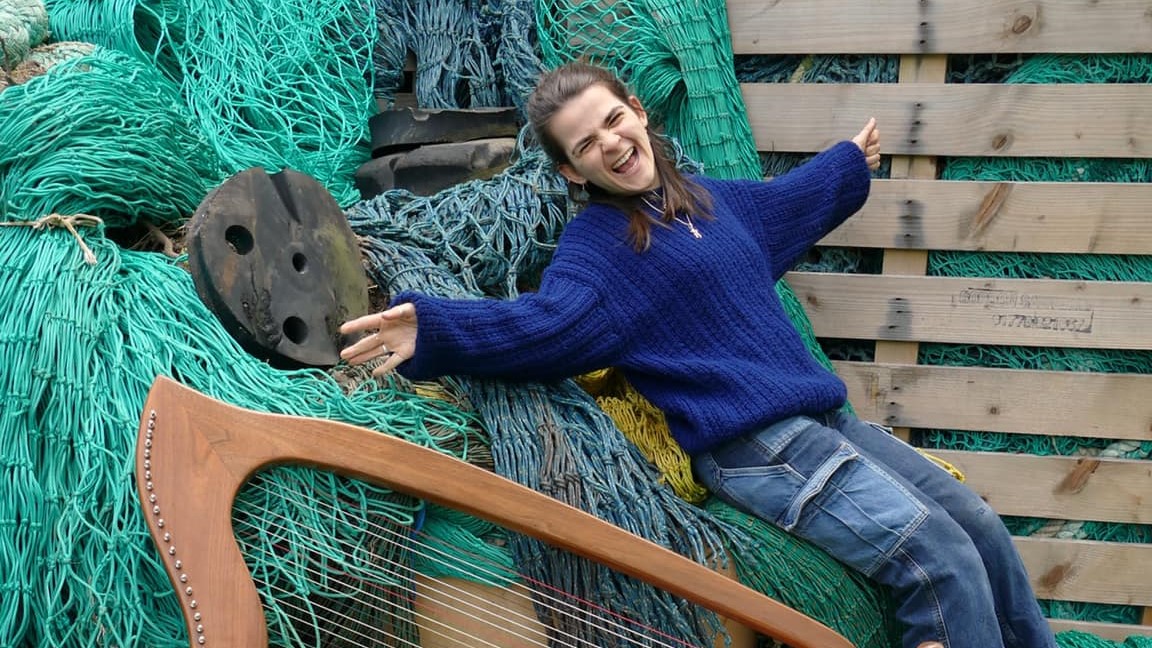
Picture: Grace Stewart-Skinner’s debut album is centred around her family’s fishing background. Picture credit: Christina Stewart/Grace Stewart-Skinner
With her debut album, Grace Stewart-Skinner takes a deeper dive into her Black Isle background by composing music around the fast-fading, fishing-focused Avochie dialect.
Almost three years ago, Grace, 25, sat down with two fishermen and one fisherman’s widow in her birthplace, Avoch – a small village in the Scottish Highlands, looking out onto the Moray Firth – with the goal to record natural dialogue about the traditions and culture of the village in its own dialect.
“It was nice to hear a lot of stories about the way of life when everybody was out at sea,” the musician said. “It felt very nostalgic – people reminiscing about the Avochie dialect, the village and fishing.”
These evocative conversations formed the basis of Grace’s debut music album, Auchies Spikkin’ Auchie, which now finds itself on the nine-strong shortlist for the inaugural Folk Album of the Year Award, made up of LPs released in the UK and Ireland in 2025.
The album, which was released in May, intertwines these interviews with her own musical compositions to create what she has described as “an encapsulating audio experience depicting fishing traditions and culture, poetry, and an essence of community”.
It sits beside 90-year-old folk legend Peggy Seeger’s album Teleology, as well as albums by Poor Creature, Barry Kerr, Joshua Burnside, Cynefin, Spafford Campbell, Gigspanner Big Band and Edith WeUtonga.
The album submission process received 146 entries. The shortlist was selected by a jury of performers, music and media professionals, chaired by folk singer-songwriter and executive producer of BBC Radio 2’s The Folk Show, Kellie While.
‘Authentically Avochie’
Grace began playing the clàrsach (harp) at just eight years old, having grown up surrounded by traditional music, but before starting her project, she had only ever composed music for four songs.

Credit: Rose Logan
She started the long, challenging process of the album by editing the hour-long interviews, with a clear vision of having a mix of voices, interesting content and as many Avochie words as possible.
However, Grace shared her apprehensions about this: “A constant concern of mine throughout the project was whether I had been creating a fair and accurate representation of these people.
“The most important thing to me is that the whole project represents a community and individual people. I am not only capturing a special dialect, but also fragments of six special people’s characters, some of whom are still alive.
“My recordings are of Avochies just speaking the way that they speak, so it really is as ‘authentically’ Avochie as you can get.”
Now based in Glasgow, the musician then spent a month surrounded by Avochies while living with her granny in the village to compose the music for the nine tracks that make up her album, before arranging her music with her band in February and recording it in Fortrose, a neighbouring town to Avoch.
“I hope I’ve captured how people used to live in a special way”, she said.
Fiddle player Rose Logan, who featured on Auchies Spikkin’ Auchie, described Boba’s – the song dedicated to Grace’s grandfather – as “really special”.
She said Grace was inspired by the Gaelic Psalm tradition from the Western Isles, where the minister in the church starts to sing the Psalm and everyone in the congregation joins in as an echo.
“You hear all these individual voices and instruments moving like a flock of birds,” Rose said. “It’s not tidy but it’s a really beautiful effect.
“Grace starts each phrase on her own and then we come in with our instruments as an echo. It’s very free and improvised, which creates a moving track that feels like the lynch pin of the whole project.”

Credit: Ewa Adamiec
Celebration of language and culture
A growing number of performers and composers, such as Catalan-speaking musicians Manel, Pau Riba, Jaume Sisa and Antonia Font, are turning their attention to dialects and languages that are endangered, with the aim to celebrate and memorialise the cultures that gave birth to them.
Standard Scottish English has been Scotland’s main language since the 18th century. However, according to the 2022 census, it is estimated that nearly 2.45 million people living in Scotland can speak or understand the Scots language in some capacity.
A primarily spoken language and not taught or used in schools in any form, the Scots language is divided into four main Scots dialects – Insular, Northern, Central and Southern – yet each of these also include other dialects, like Doric spoken in Aberdeen, Glaswegian from Glasgow or the Shetland Island’s Shetlandic.
Avochie is no different.
Unlike the surrounding towns and villages, where the inhabitants mainly spoke Gaelic, the fishermen and women of Avoch spoke a dialect of Scots that was unique to the village. The Avochie dialect combines linguistic elements of Gaelic and Scots with its vocabulary centred around the sea.
“The dialect is very colloquial, and it’s centred mainly around people,” Grace said.
But she said the dialect is fading into the past now as it was closely linked to the fishing industry and lifestyle, which has disappeared in Avoch over the last few decades.
Despite being an Avochie fisherman himself and the last one in her family, Grace acknowledged that even her dad does not see himself as a “proper” speaker of the dialect and her interviews with the fishermen often slipped into English because they wanted to include her in the conversation.
Avochie words explained
‘A postcard from Avoch’
“Fishing is not really a thing in Avoch anymore,” Grace explained as she said she herself has noticed a decline in the industry in her lifetime. “There are still boats in the harbour, but they are mainly recreational boats and there’s no real industry there anymore. This way of life has naturally faded away, and it used to be such a cornerstone of the culture.”
Since conducting the interviews, one of the fishermen who is featured on the album – Mr Lewie Patience – sadly passed away, which brought home to Grace how fragile a position the dialect is in.

Credit: Grace Stewart-Skinner

Credit: Grace Stewart-Skinner

Credit: Grace Stewart-Skinner
Click each photograph to enlarge.
“It’s an auditory postcard from Avoch,” said musician Ewa Adamiec, who played the drumkit on the album. “It provides a timestamp of what the village once felt, sounded and looked like compared to now.
“I love the track Womun because it has some strong stories about how the men went out to sea but it was the women who kept the village together.
“The album is made up of these cultural stories that you would never know unless someone tells you, but are important for capturing the history and essence of the place.”
Meanwhile Grace described the project as “a walk through the memories of fishermen” with the hope that it “shines a light on the dialectal landscape of Scotland as a whole”.
“Scotland is a country with three distinct languages – English, Scots and Gaelic – however there are only a handful of monoglot Scots or Gaelic speakers and even fewer of local dialects.
“It’s made me reflect on Scotland’s linguistic tapestry and the intense homogenisation of language we see today. There are so many small dialects in this country, and I think it’s important to not forget all these things that make the country special.”

Credit: Ewa Adamiec
The Folk Album of the Year award been created by music charity Sound Roots and the award-winning podcast Folk on Foot hosted by broadcaster Matthew Bannister.
Sitting within Sound Roots’ wider programme of events, including the Manchester Folk Festival and English Folk Expo, the winner will be unveiled at a livestreamed event at Rochdale Town Hall on 17 March 2026, with nominees performing to an invited audience of 200 musicians and industry professionals, as well as viewers from around the world.


Leave a Reply