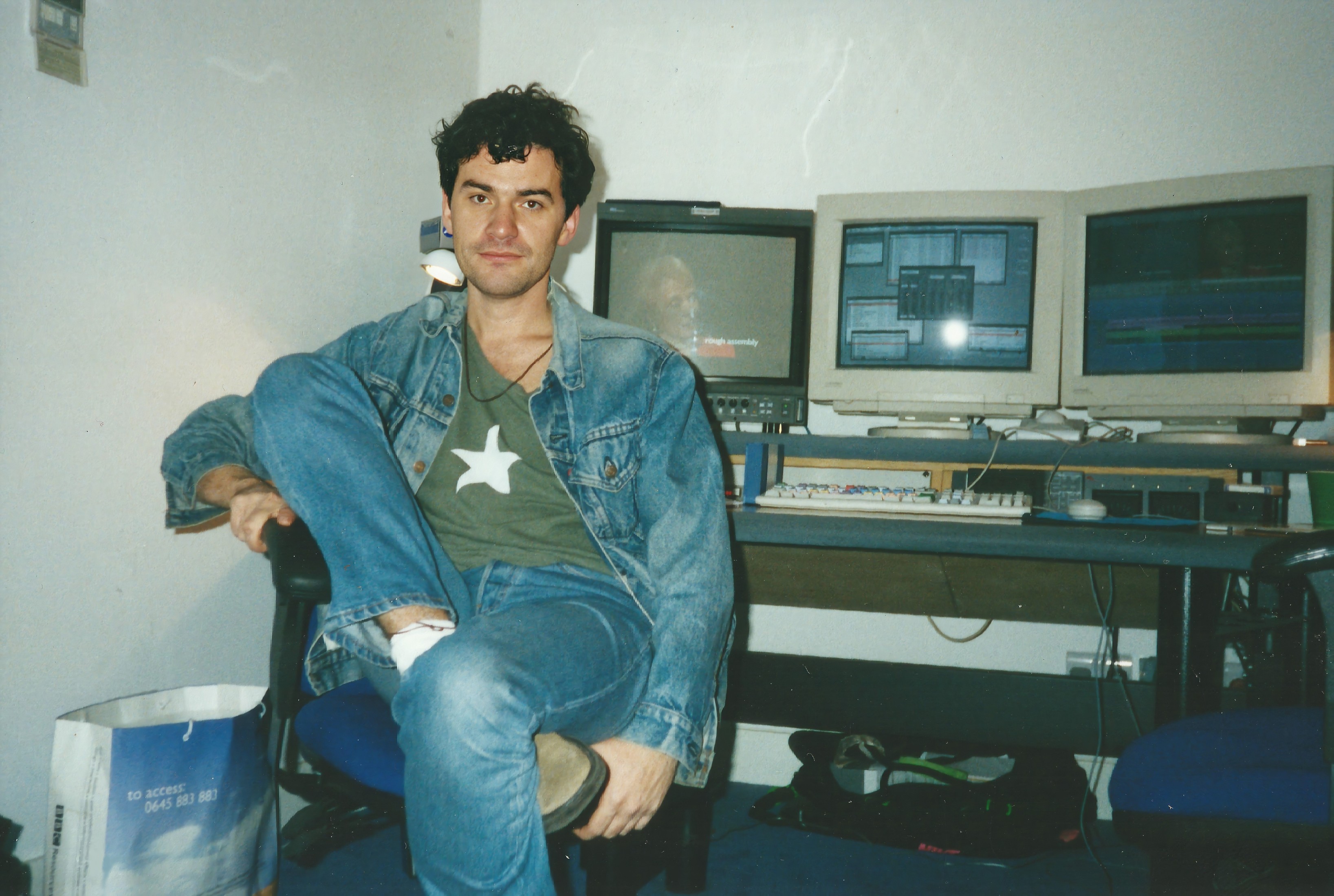
Mark Cousins editing a TV show for the BBC. Image credits: Mark Cousins.
In light of Mark Cousins’ new film, A Sudden Glimpse to Deeper Things being released this month, Fiona caught up with the Edinburgh-based filmmaker about the artist that the film explores and the significance of Wilhelmina Barns-Graham’s work, as well as the moments that have shaped his approach to cinema.
“We climbed the Alps, I carried three cameras and two tripods and three lenses and then filmed lots of different things there,” Mark says, recounting the process of filming the glacier scenes in his new movie, A Sudden Glimpse to Deeper Things. “I don’t work with a cinematographer or a sound recordist. I always shoot silent. So that keeps it very simple.”
The film is centred on the Scottish artist Wilhelmina Barns-Graham. “I discovered her in 1989,” Mark recalls. “There was an exhibition of her paintings here in Edinburgh. I was quite young then and I was drawn to her like a tractor. I’m one of those people who was never good at words, but quite good with images, particularly very constructed, engineered images. I saw her glacier pictures and I was thinking, wow, these are like machines made out of glass or something like that. I love the complexity.”
The documentary explores Wilhelmina’s life, though Mark’s approach is distinctly different. “If you know my work, you’ll know I try not to do things in the conventional way, to innovate in some way. I didn’t want to do a standard biographical picture, even though there are some biographical elements in there. I wanted to make it more about her brain and the idea of her brain meeting another complex system, which is a glacier.”
Mark refers to Willie’s self-description as “a lone wolf”, a theme which the film explores in terms of how Wilhelmina was excluded from some versions of art history. But this didn’t “deflect” her – “she didn’t try to follow fashion.”
“It is about neurodiversity, I think,” Mark continues. “I like that about her. I have tendencies towards that in myself, not trying to follow the trends in the film industry.” Willie had synaesthesia, “Best understood to my sort of non-neuroscientific brain as extra brain connections, extra neural pathways connecting things that we don’t normally expect to be connected. Like colours and numbers. We know that Kandinsky was synaesthetic, that Beyoncé is synaesthetic. If we look back now, there’s this whole new movement called ‘neuroarthistory’ where we’re looking at great artists from the past and thinking, if they lived today, would they be diagnosed as neurodivergent? Quite possibly.”
Mark describes his feature as, “A celebration of how lucky Willie was to have these extra brain connections. These made her live more fully in some way, or at least have a more sensory response to the world.” The film discusses Wilhelmina’s distinct approach to art, her tendency to look down, instead of up. “If somebody went to the Alps and didn’t paint the Alps, you would say, why not? But now we don’t see what she’s not. We see what she was doing, and that’s electrifying.”
We talk over the difficulties of creating a film based on a real person. Mark says, “I had a very nice thing recently. Do you remember in the film I say that she became re-obsessed with ice? So, this is a late picture by her, 2000, printed by the Graal Press.” He shows me a framed picture just outside his studio. “They knew her very well. They’re not in the film – I didn’t consult them or anything. They came to the premiere and a few days later I got an e-mail or a message which said, how did you know? They said, we were shocked at how well you captured her. And so, they said we’d like to give you that picture as a thank you.”
The glaciers in the film are a major turning point for Willie and her art. I ask Mark whether he has experienced such a moment that has changed his life so significantly. “I think quite often, to be honest.” He describes first seeing Touch of Evil as a child. “I thought, my God, why? I felt as if I was taking drugs. It was getting into my brain so completely. I couldn’t understand. And what the film was actually about, it turns out when you watch it as an adult, it’s about racism and sexuality and things like that. But when I saw it, I saw it as a pure formal thing, a kind of ghost train shaped as a sculptural object. And I thought, well, my brain clearly responds to the shapes of things with some entity.”
He continues, “When in my 20s, I was director of the Edinburgh Film Festival, and I went to the siege of Sarajevo, where we put films on underground during the siege. It was terrible there, 10,000 people were killed in that city in a short space of time by bombings. To be in such an intense war environment and to see that when we put films on underground in bunkers that people flocked. This was a revelatory moment for me. Particularly at the time when there’s very little food and there’s real public danger on the streets, people want art and entertainment and cinema and escapism, but also meaning. So that old idea that people need bread and roses, they need sustenance and beauty, was really locked into my brain. And I’ve carried that with me ever since.”
We see in the film how, in Wilhelmina’s later life, she meets a woman called Rowan. Mark explains, “Together they have a quiet confidence in Willie’s genius. So, they set up the foundation. Now, 20 years after she died, there’s my film and several books coming out. I wish they were around to see that she’s having a moment, and I think she’s having a moment because we’re looking back at film, at art history through a feminist lens, but also because of neurodiversity, and we know more about that than we did previously. And also, of course, about the climate crisis and the fact that the glacier that inspired her is gone. So, there’s three reasons why she’s a 21st century figure, even though she’s no longer with us.”
A Sudden Glimpse to Deeper Things is out in UK cinemas from 18 October. Find out more and book tickets to screenings here: https://www.conic.film/films/glimpse.


