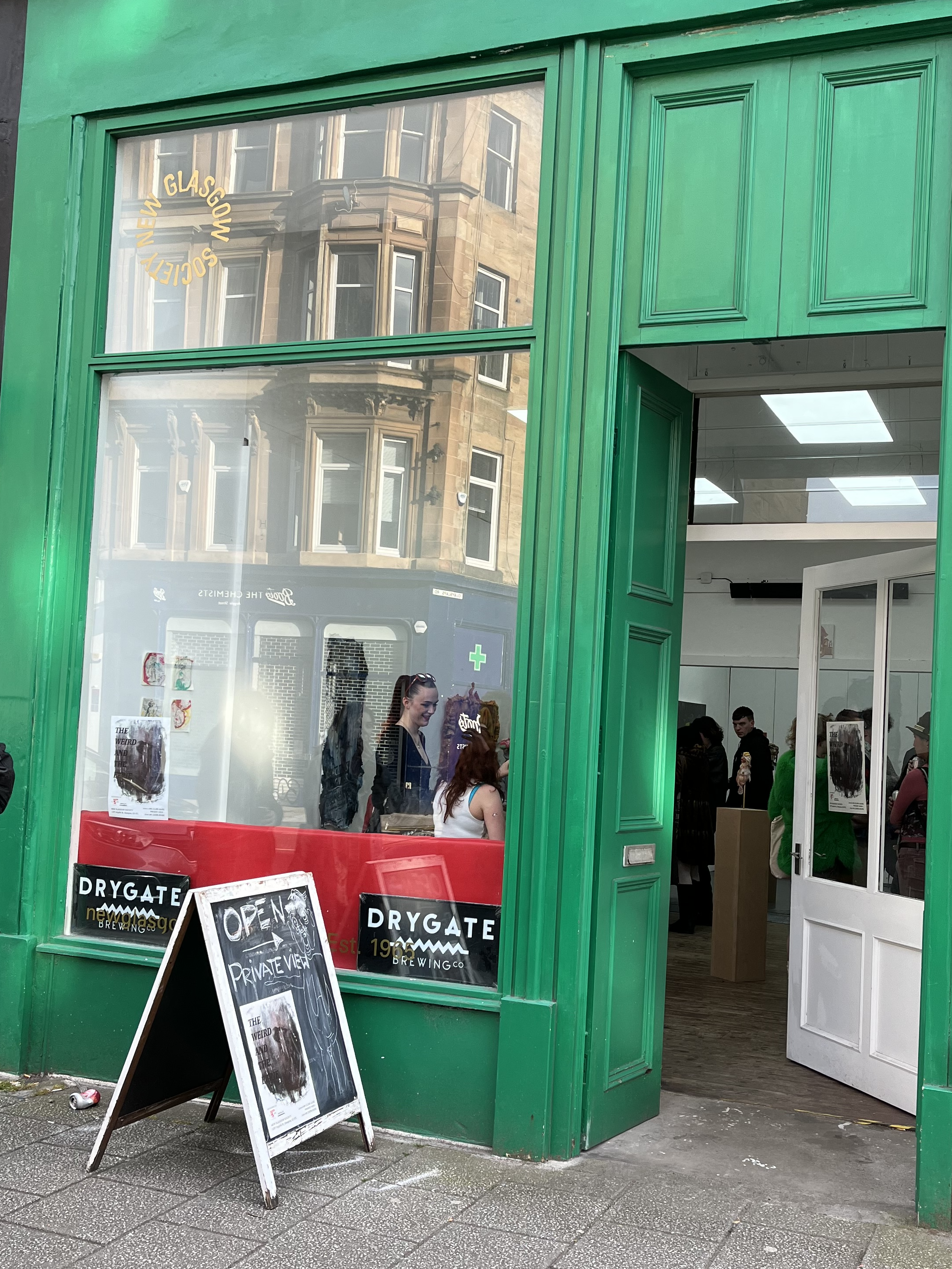
Hear from the curator of a bold new exhibition opening today in Finnieston about her ambitions to confound expectations and confront hierarchies.
The weird. The eerie. What comes to mind? Probably nothing that you’d want to welcome into your living room on a harsh winter’s night.
But in our tendencies to recoil from weirdness and eeriness, are we cutting ourselves off from an unknown world of possible exploration and insight?
That was certainly the view of the late writer and cultural theorist Mark Fisher. His 2009 book The Weird and The Eerie examined in forensic detail the meaning of ‘weirdness’ and ‘eeriness,’ exploring the function they played across 20th century popular culture.
Now, his work has inspired a new art exhibition opening today at the New Glasgow Society in Finnieston. Also going by the title of The Weird and The Eerie, the exhibition seeks to build on Fisher’s writing and translate it into the realm of visual art, exposing viewers to the “unknown and the disconcerting” along the way.
The show – sponsored by local legends Tunnocks and Drygate Breweries – features pieces from 15 students, staff, and alumni of the Glasgow School of Art. It includes work by organiser and curator Karla Healy, an MLit student at GSA, who chatted with us before the opening.
“For me, ‘weird’ is things on the outside,” she says, “the unexpected, the unknown. ‘Eerie’ is about agency, or absence of agency, or an agency that shouldn’t necessarily be there – that you wouldn’t expect to be there.
“Think of an abandoned building, or a ruined castle. If you go there at dusk, you think ‘why do I feel uneasy about this?’ It’s because you have this expectation, this knowledge of what it was prior. And your brain’s making this connection between what you know it was or could be, and what you’re currently seeing.”

One of the aims of the exhibition is to dissolve the negative connotations that ‘weird’ things, or things outside the norm, are typically burdened with. “I’ve never seen weird as bad,” says Karla. “I was called weird my entire life. I’ve never seen it as a negative. I took it as a really good sign that I wasn’t like the people who were calling me weird.”
Just as Karla welcomes the weird, so does the exhibition welcome the widest possible audience, including people who might not normally think of themselves as consumers of fine art.
“There’s a divide between art viewers. You’ve got the academics and the collectors, who want art wank, and then you’ve got the general public, and non-interested viewers – people who don’t generally go to art shows, who don’t understand what they’re looking at.
“There’s always somebody who’s got a rope standing up in the middle of the room doing nothing, with no explanation. What’s that about? It switches viewers off. I’m really keen on this idea of accessibility within art, and not switching people off.”

Clearly, Fisher’s presence looms large in the exhibition, but it is another of his books, Capitalist Realism, which Karla says has been more influential in her thinking and her practice. She argues that “art wank” reflects an elitism in the artistic world that is symptomatic of the broader hierarchies broached in Fisher’s writings.
“In art, there’s this idea of keeping the riff raff out; ‘we don’t want those people in here.’ And I think that’s really sad, because it means that culture is being dictated by a very small group of privileged people.
“When you’re looking at this idea of elitism, it holds up that system of hierarchy. Fisher’s understanding of the system is fantastic.
“It all ties in with a larger project I’m working on, looking at humans sleepwalking into their own demise, due to this inability to see what neoliberalism is doing to the world – politically, financially, in terms of the climate and ecologically.
“Let’s just leave the planet to the mushrooms.” 🍄

Later on – with thoughts of mushroom overlord supremacy drifting through our minds – we headed down to the New Glasgow Society for the exhibition’s private opening do.
The show does not fall short on its promise to confound expectations (nor, thankfully, on its promise to provide free Tunnocks and Drygate lager). Vibrant and sentient severed fingers adorn one wall, while a crucified goat-man graces another.
Only by looking upwards though does one discover that goat-man’s is not even the most sinister crucifixion on display; a group of cute bunnies in purple ceremonial dress stare solemnly down upon proceedings, as one of their own is hung behind them from a pretty pink cross.

The standout work is a painting from GSA graduate and Turkish artist Mısra Balkan. Mysterious figures and ambiguous forms blend amongst an alien backdrop, whilst the painting’s augmented frame seems to writhe and slither before one’s very eyes.

I asked Mısra what the show’s title meant to her.
“I didn’t exactly realise it before this exhibition – or maybe I just called it by a different name – but the concept of eeriness I think is something that is very prominent in my work.
“Eeriness in the sense of a kind of underlying, murky, hard to locate or define feeling that something is not quite right, or is about to go wrong, or is going to engulf you suddenly at the moment you least expect it.
“It’s like an alarm that is going off far away, but never stops ringing, and constantly reminds you that some sort of unknown threat or danger is lurking within earshot. It never lets you completely relax.”

She agrees with Karla that weirdness is not something that we need to shy away from.
“I absolutely think people are much too concerned with being normal, or not being weird. I love weird things! I think we should celebrate weirdness way more, and I think this exhibition is a fantastic example of just that.”
I couldn’t help but wonder if she shared Karla’s view that planet Earth should be “left to the mushrooms.” Her unequivocal response: “Abso-fucking-lutely!”
The Weird and The Eerie is open now at the New Glasgow Society. Free entry.


