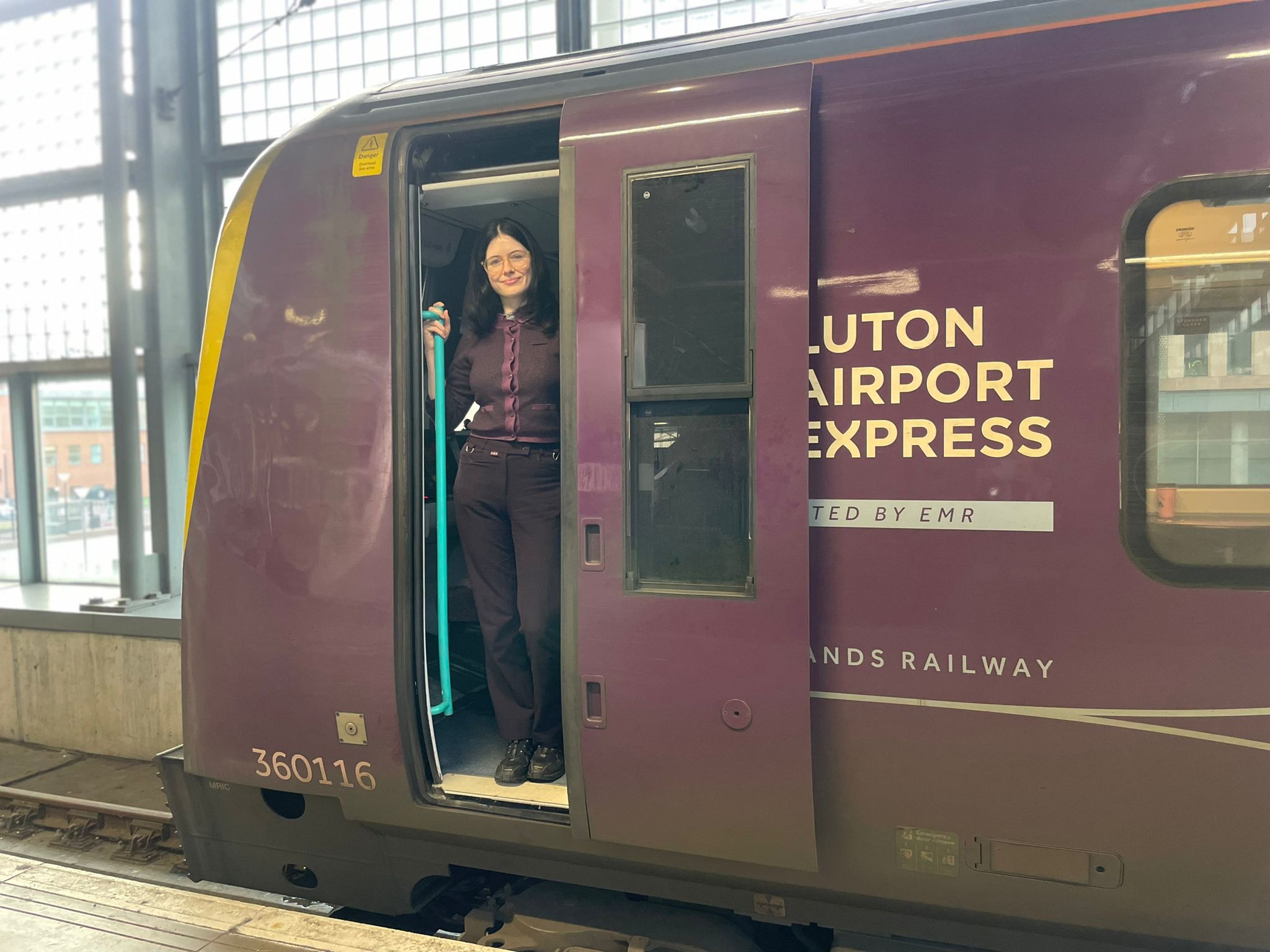
Picture: Erin Reid on her 360 train at King’s Cross
Elizabeth Ingrey speaks to 27-year-old train driver, Erin Reid, about the trials and tribulations of life on the railway, what it’s like being one of three women in the depot and the quiet moments that make it all worthwhile.
Between 2022 and 2024, train drivers became the focal point of commuter fury. A series of strikes had inner city workers typing on their laptops from home instead of in the office. “What are they complaining about anyway, they’re on 60k salaries!” was a common refrain reverberating around water coolers. To those who earned far less and were disrupted by the strikes, the complaints of these train drivers were a greedy affront. How much more money could they possibly want? But, of course, the situation was far more complicated than this, and while the ire of disgruntled commuters was, in its basis, valid, it was also misplaced.
“Everyone thinks that train drivers just strike for money, and they’re not wrong, we do strike for money,” says Erin Reid, a 27-year-old train driver at East Midlands, “it’s not just the pay though, it’s also to do with wanting to cut pensions, it’s to do with making early shifts earlier and late shifts later, it’s to do with adding in more and more work, which is then making it less safe because drivers are fatigued.” The list of complaints continues: the conditions of the breaks are shocking, the toilets constantly overflow (“some trains don’t even have toilets”), the railways themselves are in disrepair, and the prices keep going up without any improvements being made.

As a 27-year-old female train driver, Erin is something of an industry anomaly. According to recent figures, fewer than one in ten drivers are women, with the average age being 46. In Erin’s depot at London’s Kings Cross, she is one of only three women – there are 66 men. And although she admits to having had a generally positive experience, there are some niggling irritants. “I have a lot of men who…say that they’re like my dad. I appreciate the sentiment of what they’re trying to say, but I have a dad and I don’t need a work dad.” Her mother, Nuala, often thinks about how she has remained confident despite her age, noting “she’s a strong woman whose young looks belie her strength.” But as is often the case, this youth sometimes leads the men to baby her. “They undermine my experience,” she says, “even if I might have the same level of experience as them.”
Erin has been in the industry since 21, meaning that she has the same number of years on the job as some colleagues nearly double her age. “I was training with a range of ages up until 60,” she recalls, “so they don’t discriminate on age, which I was quite surprised about because it costs a lot of money to train a train driver and you’d think they might be retiring shortly.” Southeastern, where Erin started out, is known as the ‘training school’ among drivers, as they have a higher tendency to take in newbies. Others, like East Midlands where she currently resides, rarely front the cash for traineeships, which lowers the percentage of female drivers who tend to be young intakes.
Recently, the age at which one can become a driver was lowered from 21 to 18 years. Reflecting on this development, Erin recalls the words of her older co-workers: “A lot of the guys I work with say that there’s no way they could have been a driver at any point in their 20s because you have to give up a lot of life.” Apart from the ZERO drugs and alcohol policy – Erin even avoids poppy seeded desserts as this could produce a positive test for opium – there are also the unholy work hours to attend to that see-saw from 5am to 11pm starts. “When I first joined in the induction, they mentioned how shift work affects your life expectancy,” she says with some lingering concern, “and every week I say I’m going to get my sleep sorted, but it’s just impossible because you’re constantly jumping about.”
Unsurprisingly, the schedule is not conducive to successful relationships, especially with those not on the rail. Erin recalls at 21 being asked by a rather brash woman if she had a boyfriend. After answering in the affirmative, the lady responded, “ha! that won’t last long.” And while it’s true that that relationship did not last, after six years in the business, Erin has become more creative: “[My boyfriend and I] had to go for a swim in the morning as a [second] date because I was on night shift. But you know, that’s a good sober date. That’s a good way to get to know someone. In the freezing cold water [it was outside], his lips were turning blue, no alcohol to ease the nerves.”
Getting the job in the first place was also no easy task. After months of interviews and psychometric tests which assess your reaction times and concentration, if there is no job available you will be placed into the mythical no-mans-land of the talent pool. Worse still, if no job becomes available within two years, you have to complete the entire process again. Luckily for Erin, a position opened up within a month of her passing her exams: “I can’t remember how many…tens of thousands applied for the job, and I got down to the final six and I got the job.” A sort of Heraclean labour of tasks, it makes the successful candidate a rarity. To know one is to know, for instance, an unlikely superstar who against all odds made it to Hollywood, like Bob Hoskins.
For many readers, the pay probably doesn’t make up for the sleepless nights on blow-up mattresses, or the unsociable work hours that have you skipping drinks at Christmas dinner, or the ping-pong schedule of lates-earlies-lates-earlies. But for Erin and other drivers alike, when you get on that train, and the hills open up before you, seemingly just for you, there is a quiet bliss that makes it all worthwhile. “I’ve seen the most beautiful sunrises, the most beautiful sunsets, the craziest, biggest moons…you have the best view, and I’m just like, wow, I get paid to do this.” In that first of first class seats, you’re privy to deer bouncing across fields, pheasants, bunny rabbits and birds of prey sweeping through the vistas (though admittedly Erin does sometimes run them over). Sure there are downsides, but life is about sacrifice and, at the end of the day, Erin won’t be taking any work home with her. I wish I could say the same for myself.


