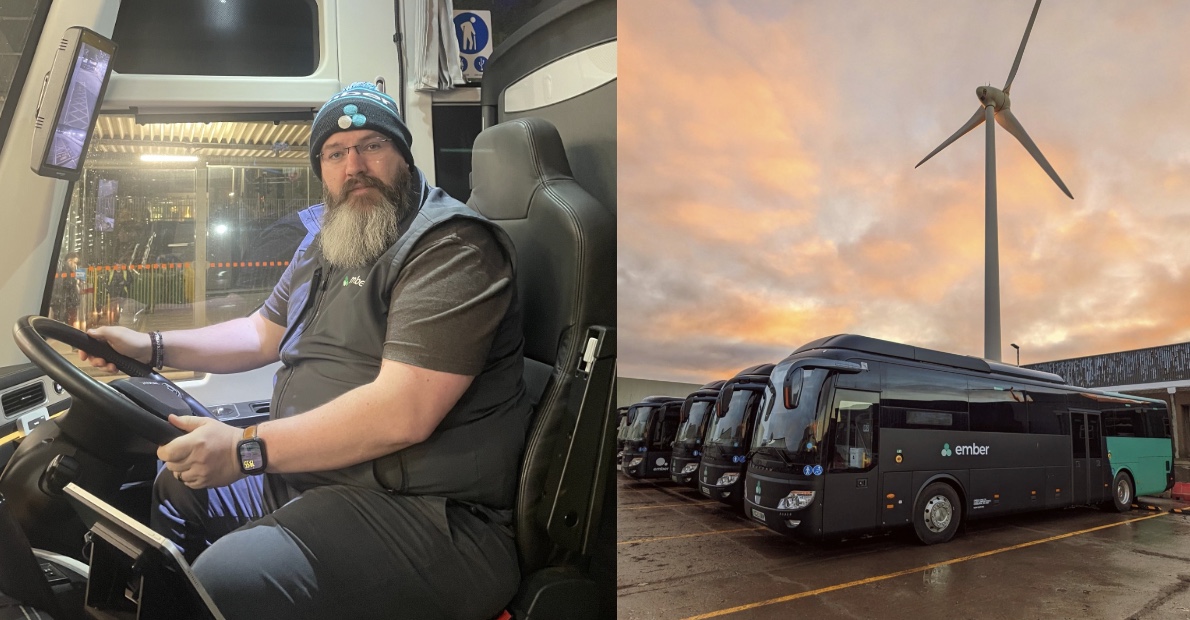
Image credits: Marco Suttie (left) and Ember (right)
As Ember rapidly expands its electric powered coach network across Scotland, drivers like Stephen Jameson are at the forefront of the journey. He talks us through the highs and the lows of working for one of the UK’s most ambitious young companies.
I check my watch anxiously for the fifth time in a minute. Stephen still hasn’t arrived.
All around me, commuters weave through the station, scarves pulled tight against the February evening chill. As Glasgow’s Buchanan Bus Station clock ticks, my stress rises. Stephen’s bus is due to depart in three minutes and he isn’t even here yet. Will I have time to take my oh-so-important photos and ask my follow-up questions?
Just as I’m about to give up, text message already drafted suggesting another day, the E3 bus pulls into stance 53, Stephen has arrived. His night service to Inverness is due to leave in one minute, yet he shows no sign of stress.
Within minutes he’s chatting with a colleague, wiping down the coach and greeting passengers as they board, all while politely answering my questions.
As Ember continues its rapid electric expansion across Scotland, drivers like Stephen are on the frontlines of a transport transformation that brings enormous pride and occasional challenges.
Ember’s rapid expansion
Ember entered a crowded Scottish bus market in 2020, launching its Dundee to Edinburgh route with an initial fleet of just two buses. Fast forward to today and it has more than 80 buses, serves 100,000 monthly customers and boasts a network covering the whole of Scotland.
Click through to see Ember’s network growth since its inception:


Stephen puts this impressive growth down to the company’s focus on customers’ needs. He says founders Pierce Glennie and Keith Bradbury have “come at it with a completely different approach” compared to other bus companies.
Glennie and Bradbury are not ‘bus people’, Stephen tells me. Prior to founding Ember, they both worked in tech roles in London before being inspired to start a bus company that could be an environmentally friendly alternative to driving a car.
He highlights the functionality of the website, the ease of rolling tickets onto the next bus, and the importance placed on interacting with passengers. Drivers are encouraged to greet passengers by name when they board.
“Small things like that make a huge difference.”


What really distinguishes Ember from competitors like Stagecoach and FlixBus, however, is the electric aspect. One hundred per cent of its fleet is powered by electric, making it the first fully electric intercity coach service in Scotland.
Limitations of electric
This isn’t Stephen’s first experience driving electric buses. He has driven buses in Scotland for fifteen years, after moving here from Sandhurst in Southern England and his experience in the industry means he’s driven a diverse range of vehicles, including a summer spent on Glasgow’s electric powered open top tour buses.
A fully electric network, however, brings its own challenges and opportunities.
He says “range anxiety” can be a real stress: “I’ve arrived in Inverness with two percent charge before. The bus has to have a minimum of 65 percent to get up to Inverness, so if the weather conditions are bad it can get really close.”
Two weeks ago, he adds, a bus was forced to pull in and transfer its passengers after running out of charge.
In regards to this incident, an Ember spokesperson said: “In this particular example, there was an unexpected issue with a cold battery that we’re still investigating, and the bus was withdrawn in order to prevent it running out of charge. Our 24/7 Operations team always monitor to ensure that the buses don’t actually run out of charge on a live trip, but are rather pulled over in a safe place if a concern arises.”
On the whole, though, Stephen is extremely positive about Ember’s fleet, calling it “far superior” to competitors like FlixBus. He adds that concerns around range anxiety should ease when the fleet is updated in April.
“Our current buses can do about 380 miles to a charge and the new ones will do 400.”
Talking to Stephen, it’s clear he derives real pride in working for a company that is “shaking up the industry,” as he puts it.
“I get a sense of pride from it because they’re brand new buses. It’s just nice to do a good job for the customers.”
How is Ember different for drivers?
While Stephen draws pride from Ember’s modern technology and rapid expansion, is there increased pressure on the drivers at the frontline of this growth?
“With expansion comes a need for more drivers. There was a time in the run-up to Christmas when the Inverness depot was really struggling, but now all of a sudden they have 40 drivers.”
He says Ember is refreshing in its approach to drivers:
“It just feels different. Unlike Stagecoach or First Bus, they put a lot of emphasis on the driver being valued. Basically, without the drivers there’s not a business, so they try and look after us as much as they can.”
Stephen speaks about his young family with pride and chooses to work the night shift so he can spend more time with them during the day: “I’m here for when they go to bed and when they leave for school in the morning.”

(Image credit: Stephen Jameson)
He also values attending church with his family, and Ember agreed to give him every other Sunday off to make that possible.
“I didn’t even ask for it, that was something they suggested at interview stage. I absolutely wouldn’t get that at another bus company.”
It’s obvious why Stephen sees his future at Ember. It’s an expanding company that, in his view, treats its drivers far better than others.
“I don’t think I’ll go anywhere else. I’m very happy here.”
What does the future hold?
Ember will need to keep drivers like Stephen on board if it wants to fulfil its lofty ambitions. Since launching in 2020, the company has consistently added new routes, and its services now criss-cross the country. But they’re not stopping there.
“You haven’t seen anything yet,” Stephen tells me. “The plans they’ve got for this year are ridiculous.”
Having recently opened a Glasgow to Fort William route, there will soon be a service from Fort William to the Isle of Skye. Three new depots are also being built, including one in Glasgow. Once these depots are operational, Stephen says Ember will begin services into England, with Scotland to London services likely in future.
An Ember spokesperson said: “It’s true that Ember has ambitions to launch in England at some point, but the exact timeline and locations are not confirmed.”
While the specifics remain unclear, the ambition is not. At interview stage, Stephen says he was told their “grand plans were basically to take over the world – and they weren’t joking.”
As I wrote this article, I was niggled by the fear that it reads like an advert for Ember. I pestered Stephen for negatives to avoid drifting into puff-piece territory. But at a certain point, forcing balance would be disingenuous. Stephen loves working for Ember, that much is clear.
Like any job, there are bad days, difficult colleagues and moments when you simply can’t be bothered. Still, I’m struck by how rare it is to meet someone who radiates genuine pride in the company they represent. Stephen’s experience suggests a company can expand while treating its employees with dignity and respect – because, as he says, “without drivers they don’t have a business.”
As the last passengers climb aboard, Stephen waves goodbye, checks his mirrors and pulls away from stance 53 with barely a sound. Earlier I’d been anxiously checking my watch; now he leaves entirely unhurried. For him, it’s just another shift. For Ember, it’s part of something bigger – an ambitious expansion powered forward by its drivers: steady, proud and confident about the direction they’re heading.


