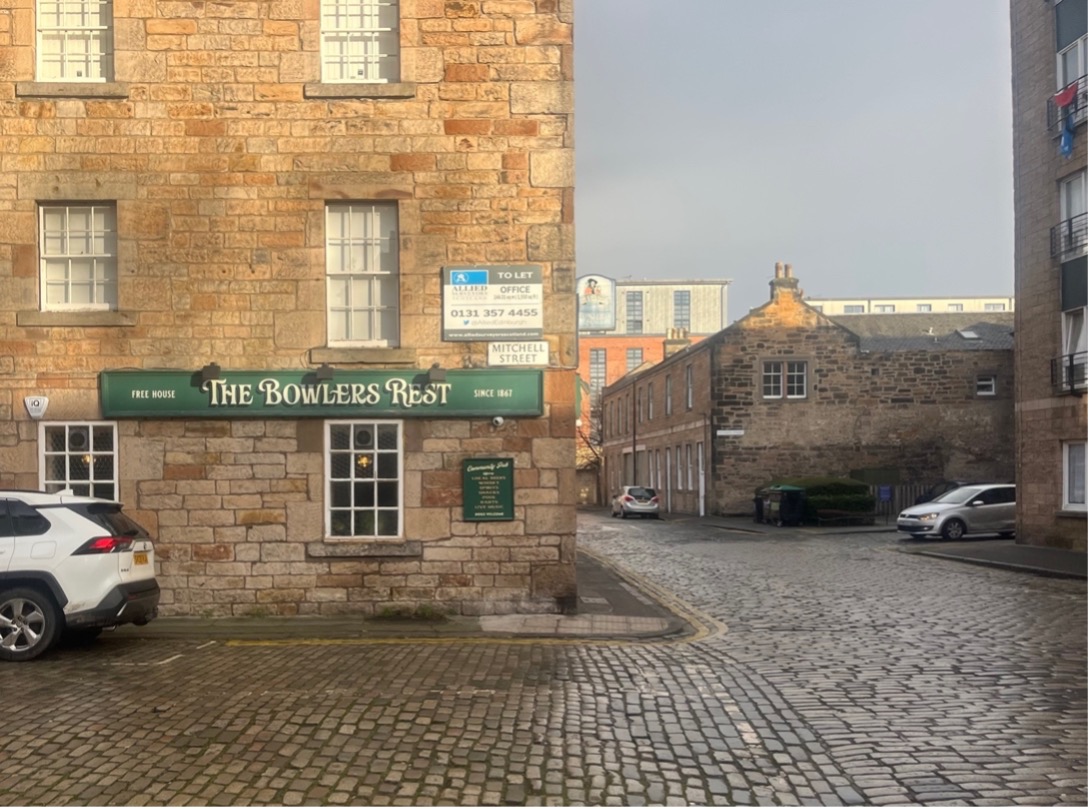
Photo: The Bowlers Rest in Leith. Credit: Adam Clements
As the old community institutions of Leith deteriorate in numbers with the area’s ever-intensifying gentrification, “community pub” The Bowlers Rest seeks to keep its identity as it evolves.
On a Wednesday evening in The Bowlers Rest, several older regulars nurse pints of Tennent’s as ’80s classics play from the jukebox. An older couple begins a game of pool against two young musicians. Meanwhile, a queer open mic night is underway in the lounge.
The Bowlers stands in the heart of Leith, a former industrial hub in Edinburgh which has undergone a well-documented, decades-long process of gentrification. Pubs in the area often fall distinctly on either side of the social divides stoked by that process.
Some feel like caricatures of opposing stereotypes: the ‘gentrified’ pub with expensive craft beers and an elevated food menu and the traditional ‘old man’ pub with frosted windows and several cheap lagers on offer.
The clientele in these disparate worlds lay bare the broad socioeconomic spectrum of modern Leith, a densely populated area where housing costs have risen at alarming speed.
Increasingly, the latter sort of pub is disappearing: popular Hibernian pub The Harp and Castle went on sale this month, the Tam O’ Shanter rebranded as Leith Social Club last year, and longstanding pub the Lord Nelson will reopen in several months as a wine bar.
Among surviving old community institutions, most cater primarily to older, long-time Leith residents. The Bowlers Rest is something of an anomaly, pulling off a balancing act between two sides of the Leith community which elsewhere feel wholly disconnected at times.
Cecely Chambers, an American who purchased the Bowlers with her husband in 2022, worked as an interfaith chaplain in paediatric palliative care before moving to Edinburgh.
“Being a chaplain, I really wanted to invest in community, so I said we should get a pub,” she says. “This pub went up for sale two weeks after I got here. And I came in, I was this little American with my cute little backpack on and there were about three old men sitting around and an old man behind the bar and they welcomed me super warmly.”

“Two old guys in the corner were telling me, ‘this is my church, we come here every Sunday,'” she recalls. “The barman’s telling me all about the pub and all the characters, and that it used to be owned by [Hibernian and Scotland footballer] Lawrie Reilly and how it was just this important community pub, and I fell in love immediately.”
On that first visit, Cecely asked the patrons inside: “how would you all feel if a couple of Americans bought your pub?”
A taxi driver at the bar looked up from his newspaper to reply: “as long as you don’t turn it into a yuppie wine bar, we’re fine.”
“We’ve really tried hard to keep the spirit of the pub the same”, says Cecely. “Our vision always for this place was to keep a traditional feel and to keep it accessible to the people who live, work and visit Leith.”
“I knew that I would never become a millionaire from this pub, so we’ve tried to keep our prices really low. Our margins are much lower on most of our products than some of the other places around here because, again, we want people to be able to come here.”
One regular, sat at his usual barstool, shares that he has frequented the Bowlers for 56 years. When asked how many other pubs he used to frequent have closed or no longer interest him, he chuckles and holds up ten fingers, then raises another five again.
Cecely and her husband did make one significant change: introducing a stage and several instruments to the lounge, which now hosts a wide range of musical events led by local community members.
“The lounge being a musician space, the main pub being a traditional space, and then people come together over the pool table was my vision,” she explains.
The culmination of this ambition is evident in the ostensible contradictions of that recent Wednesday, and further still at the weekly Sunday bluegrass jam, during which the lounge is crammed to capacity with musicians of all ages and skill levels. As the session dissipates and drinks continue to flow, the range of characters in the pub gradually merge toward a cohesive community by the evening’s conclusion.

Ben Errington, a musician who co-leads the Sunday session with his band, Sociograss, says he played sparsely attended events at the pub for months before word started to spread in the music community.
“I’m told that the back room was once just used for occasional parties and perhaps a bit of karaoke or sport,” Ben recalls. “Now, there’s music there near every night, and the Bowlers Rest has become Leith’s new social hub for music and one of the most valuable and inclusive community spaces.”
On its signage and social media, the Bowlers frequently emphasises its identity as a “community pub”.
“I want it to be representative of the people who are here. I don’t want it to be just the people who’ve been coming here for 20 years or 30 years. I want it to be like a little snapshot of Leith in here every night”, Cecely says, defining her understanding of this identity.
“There are a lot of old people in Leith still, and there’s a lot of young people in Leith and there’s hipsters in Leith, there’s working-class people in Leith and we really have that range.”
“It is such an enormous honour, privilege, gift that I got to take over this wee pub,” she reflects. “I have worked really hard to keep the spirit, this beautiful, magical spirit of this place, and to just infuse it with love and gratitude and pride of being part of this amazing community. And I’m so, so grateful.”
The Bowlers Rest is not the only Leith pub that has sought to maintain its old identity. But it is unique in presenting an alternative vision of how community institutions can adjust to gentrification: one in which new faces are incorporated into old traditions before they can displace them.


