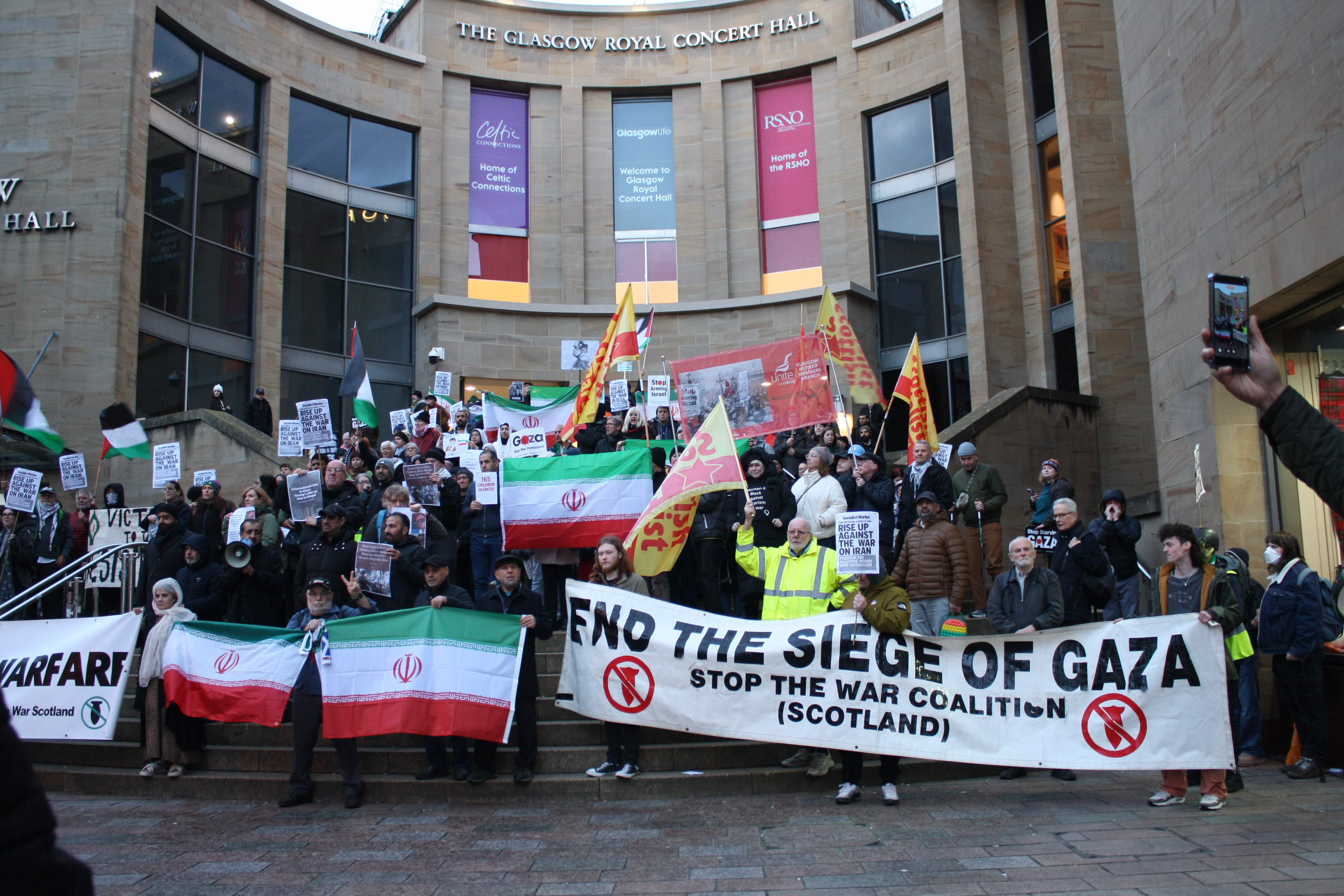
On a rainy Monday evening, about a hundred people gathered at Buchanan steps to protest the US and Israeli-led assault on Iran which began the previous Saturday.
The March 2 demonstration, called by Stop the War Coalition‘s Glasgow chapter, had been arranged on short notice given the urgency of the situation.
“I thought it was really good to see so many people come out at such short notice to say they don’t accept any of the US lies about how [they’re] trying to spread freedom and democracy,” said Jade Eckhaus, co-chair of Stop the War Scotland, in an interview with The Clyde Insider.


Following the initial attacks on February 28, which killed Iran’s leader Ayatollah Ali Khamenei, at least 1000 civilians have been killed, with US-Israeli strikes hitting civilian infrastructure such as schools and hospitals. The Iranian government has retaliated by attacking Israel and US military bases across the Middle East. At least 13 people in Israel, 17 in the Gulf states, and 8 US soldiers have been killed.
The speakers, mainly representatives from Palestine solidarity and Muslim organisations, likened the present situation to previous US-led interventions in countries in the Global South, such as Afghanistan in 2001, Iraq in 2003, Libya in 2010, and most recently, Venezuela in January 2026.
“In Iraq today, from depleted uranium used to devastate the country, there’s still birth deformities in hospitals,” said Mick Napier, representing the Scottish Palestine Solidarity Campaign. “They want us to suffer from amnesia, but we must remember the past to understand the present.”
On February 28, the Gaza Genocide Emergency Committee called an emergency demonstration in response to the first wave of attacks on Iran. This demonstration was disrupted by counter-demonstrators waving Israeli flags and holding pictures of Reza Pahlavi, the son of Iran’s former shah.
The following day, people gathered in Glasgow to celebrate Khamenei’s death, once again waving US and Israeli flags alongside the Lion and Sun flag used before the Islamic Revolution in 1979.

Mohammad Asif, Director of the Afghan Human Rights Foundation warned those celebrating the attacks on Iran to look to his country of Afghanistan as a warning for what US intervention brings.
“Look at the state of my country, Afghanistan,” he said. “20 years later, where British soldiers were killed, nearly 300,000 Afghans were killed. You know what Britain and America did? They replaced Taliban with Taliban.”
What is Britain’s involvement in Iran?
Britain has been involved in Iranian affairs since the beginning of the 20th century, mainly through the activities of the Anglo-Persian oil company, currently known as British Petroleum (BP).
In recent history, Britain has intervened in several conflicts in the Middle East, often alongside the US. This includes the Gulf War against Iraq in 1990-91, the Iraq war from 2003-09, the invasion of Afghanistan from 2001-2021, the Libyan Civil War in 2011, Yemen from 2014, and operations against ISIS from 2014.
On March 1, Prime Minister Keir Starmer stated that the UK was not involved in the initial strikes on Iran, but has now granted the US permission to use UK military bases for “defensive purposes.”
“I want to be very clear: we all remember the mistakes of Iraq,” he said. “And we have learned those lessons.”
According to Starmer, at least 200,000 British citizens are currently in the region, and many are affected by strikes on hotels and airports where they are staying.
Strikes have also hit RAF Akrotiri, a controversial British military base in Cyprus from where the RAF has launched at least 518 spy flights over Gaza since December 2023. Other UK military bases have narrowly avoided being hit, as they are located close to US bases targeted by Iran.
“The UK has been complicit, and a key part of the genocide in Gaza, in Palestine, over the last two years, [and] the occupation of Palestine for past 75 years,” said Eckhaus. “Part of the reason why we have to come out to oppose [war] is to oppose our own government and their role in murder and slaughter throughout the region.”
The map below shows UK (red) and US (blue) military bases in the Middle East, with those used by both countries in purple.
Map Source: OurCommons Library (UK), American Security Project (US)
How have Scottish politicians responded?
What parties in the Scottish Parliament have said about the war:
Scottish National Party (SNP)
First Minister John Swinney has said that he is “deeply concerned” about the escalation following the US and Israel’s attack, and suggested that these countries were not acting in accordance with international law.
Swinney has also said that he would consider banning US military aircrafts from Prestwick Airport if it were clear that the aircrafts were involved in strikes in the Middle East.
Scottish Conservative and Unionist Party
Russell Findlay, leader of the Scottish Conservatives, retweeted Swinney’s statement saying “Get on with the day job John!”
Scottish Greens
The Scottish Greens have condemned the strikes and called for a “robust international response.”
“We can not stand by and allow yet another devastating regional conflict to unfold. Our hopes are for the safety of the Iranian people, who now have to fear both their own government’s violence and that coming from Trump and Netanyahu,” said MSP Patrick Harvie, external affairs spokesperson for the party.
The Greens have recently criticised Swinney for not taking decisive action to ban US military aircrafts at Prestwick Airport. MSP Ross Greer argued that it was “abundantly obvious” that these aircrafts were being used to assist attacks on Iran.
Scottish Labour
Scottish Labour leader Anas Sarwar has come under heat after his father Mohammed Sarwar posted a tribute to Khamenei following the leader’s death. He has rejected his father’s views, and described Iran as a threat to its neighbours and the UK, while also calling for de-escalation.
Reform Scotland
A Reform UK spokesman told that Clyde Insider that “Nigel Farage has been calling for the UK to protect its sovereign territory in Cyprus. The Prime Minister belatedly did the right thing but it’s clear that Keir Starmer is a follower, not a leader. We want to see a swift end to the war.”
Scottish Liberal Democrats
Scottish Liberal Democrats leader Alex Cole-Hamilton has said that “The Prime Minister must not let Trump drag Britain into another prolonged war in the Middle East. The UK must not be complicit in illegal military action.”
He has supported UK Liberal Democrats leader Ed Davey’s call for Starmer to put the decision to allow US use of UK bases to a vote in parliament.
“Part of the reason why we have to come out to oppose [war] is to oppose our own government and their role in murder and slaughter throughout the region.”
Jade Eckhaus, Stop the War Scotland
What happens next?
Recent polling by YouGov shows that public opinion in Scotland and the UK as a whole is still divided on how the UK should respond to the war unfolding between the US and Iran.
Approximately half of people surveyed on March 2 opposed the US’s military action against Iran and the decision to allow the US to use UK airbases. The most popular responses are for the UK to neither praise nor condemn the US and engage purely to defend civilian and UK military areas.
Eckhaus called for those who oppose war on Iran to take to the streets, just as many have done to oppose Israel’s genocide in Palestine over the past two years.
“We need to build a serious anti-war movement,” she said.
Protests continue to be organised across Scotland. On March 7, anti-war protesters marched on the US Consulate in Edinburgh to call for an end to aggression against Iran and the US military’s presence in Scotland.
Stop the War Scotland is organising a national demonstration in Glasgow on April 11 calling on Scotland to break with US militarism.


