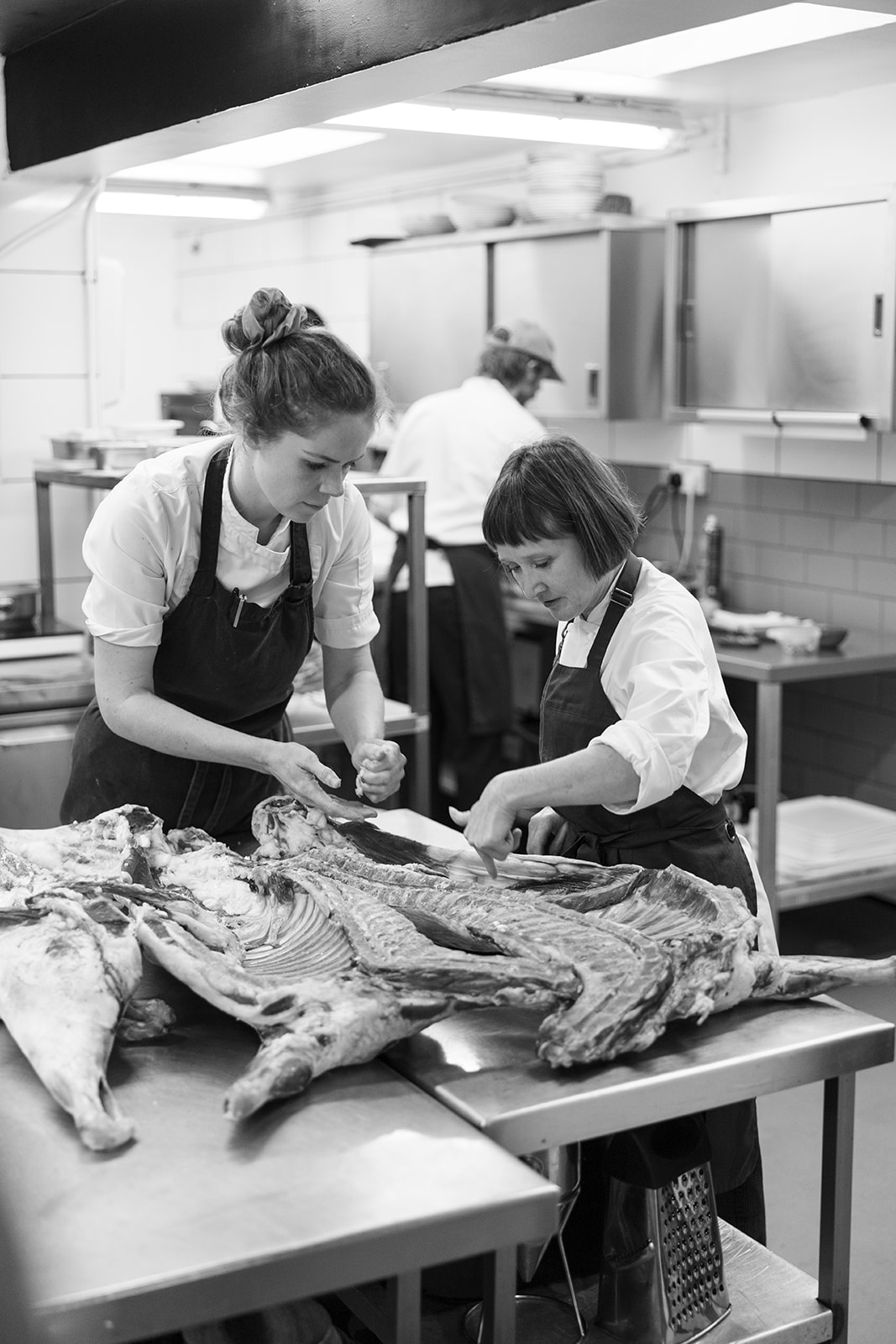
Fiona speaks to women working in kitchens across Scotland about their experiences, what has changed, and what the future looks like.
“It is still an emphatically patriarchal society that we live in,” states Pam Brunton, referring to her thoughts on the place of fine dining kitchens in wider society. “It was built by men, and it’s only very slowly being unpicked.”
Pam Brunton, chef and co-owner of Inver, a restaurant in Argyll and Bute, is one of several female Scottish chefs and restaurant owners currently in the limelight. Roberta Hall-McCarron, chef and co-owner of three Edinburgh-based restaurants including The Little Chartroom and eleanore, is another.
Pam Brunton, Argyll and Bute
Pam’s restaurant Inver is currently the only one in Scotland to be awarded a Green Michelin star for sustainability.

I’m lucky to catch her on a Tuesday, one of her few days off. She chats to me over the phone about her thoughts on the lack of female representation in fine dining kitchens. “It’s not just about increasing the head count, but also about what’s going on in the heads, and that is a process.”
She emphasises the need to look at this in its broader context, highlighting that you’re “also mirroring what’s going on in much wider society. We’re not operating in isolation.”
Pam’s recently published book, Between Two Waters: Heritage, landscape and the modern cook, touches on the idea that women have taken up space in kitchens for as long as they have existed, just less so in the fine dining or ‘professional’ kitchens where they are underrepresented.

Data from surveys by the Office for National Statistics details the number of persons in different employment, by sex, across the UK. The most recent statistics are from the period of October 2023 to September 2024.

Findings from the survey highlight that, during this period, males make up almost 30% more of the total number of persons in food preparation and hospitality trades, when compared to females. This sector includes butchers, bakers and flour confectioners, fishmongers and poultry dressers, chefs, cooks, and catering and bar managers.

Looking in depth at these various roles, we see how the number of males identifying as ‘chefs’ is almost triple the number of females. However, also clear is the larger number of females in the industry who identify as being ‘cooks’.
Pam acknowledges the breadth of places where people can work as chefs, widening the perspective on what a ‘chef’ actually is. She refers to both public and non-public sector kitchens where “there’s a whole diversity.” Importantly, she makes the point that “fine dining has a particular role to play,” and ‘cooks’ or ‘chefs’ across all sectors each have value in their own right, arguing that no one should be seen as any more important.

Valeriia Minenko, Ukraine and Edinburgh
Valeriia Minenko is a chef from Ukraine who now lives in Edinburgh. Watch the video below to hear about her experiences in kitchens in the two different countries and what she still feels needs to change.
Roberta Hall-McCarron, Edinburgh
I meet Roberta in the basement of Ardfern, the newest venture for her and her business partner and husband, Shaun. Since getting a dish on Great British Menu in 2021 and winning Squaremeal’s award for Scottish Female Chef of the Year, she expresses her gratitude but also takes time to acknowledge the attention that has come with it.
She says, “I want to use my position in a powerful way to try and make change, but I want it to be on my own terms. Because again, what’s the point if you’re still a woman that’s getting pushed around into this corner, pushed into that and you’re going to do this, you’re going to do that. I’ll be a voice, but I’ll do it in my own time.”

Roberta recalls comments she heard early on in her career. “I remember old head chefs saying to me we’ll never employ a girl because she’ll get pregnant.”

Speaking on her personal experience, she says, “I always knew that I wanted to have a child, but I also wanted to have my own restaurant, and I was determined to do both.” Roberta also published her first cookbook, The Changing Tides, last November.
“No male chefs get asked these questions,” she says, expressing her frustration about being constantly asked how she balances her job with her home life. “‘Oh you’ve got a family; how do you manage that?’”
We chat about developments in the industry. Roberta tells me about a group chat for female chefs that Sally Abé of The Pem, set up; she is one of the admins for the group. “It’s a safe ground for women to go on and be like, oh god, this happened to me this week, has everyone ever done this when they’ve had this sort of day?”
“And it’s like yeah, I’ve totally done that. And you’re not alone at all.” She describes it as also being a space to share opportunities for other women in the industry.
Gravitating towards change
What’s evident in all my conversations is the need for change regarding the attitudes, and organisation of kitchens in general, as well as addressing gender issues.
Pam tells me that Inver rejects the “top-down” traditional approach to running a business. She speaks about her commitment to challenging the definition of what is classed “excellent” in the industry.
She says, “Three-star Michelin kitchens who are treating their staff like ****. That’s not excellent. You don’t get to pursue excellence by any means necessary. There’s no exterior being that’s like defining excellent for you. Human beings define what excellent is.”
Roberta discusses how her past experiences have influenced how she treats her staff. “I’ve been shouted at. I’ve had things thrown at me. I’ve had everything under the sun. And I look back, and I think that’s not a way to live. I don’t want anyone coming into my kitchens to be feeling that way.”

It’s evident that things are changing, but there is still a long way to go.
Speaking on the change and looking forward, Roberta adds, “I do think there is such a focus on women, and I feel like with that focus, more women are coming and doing things and are feeling supported and I really, really want to start seeing more women applying for jobs. I don’t know if we’re at that extreme turning point yet, I think we’ve still got a hell of a long way to go, and we have a lot of work to do. But I do think that things have changed.”


