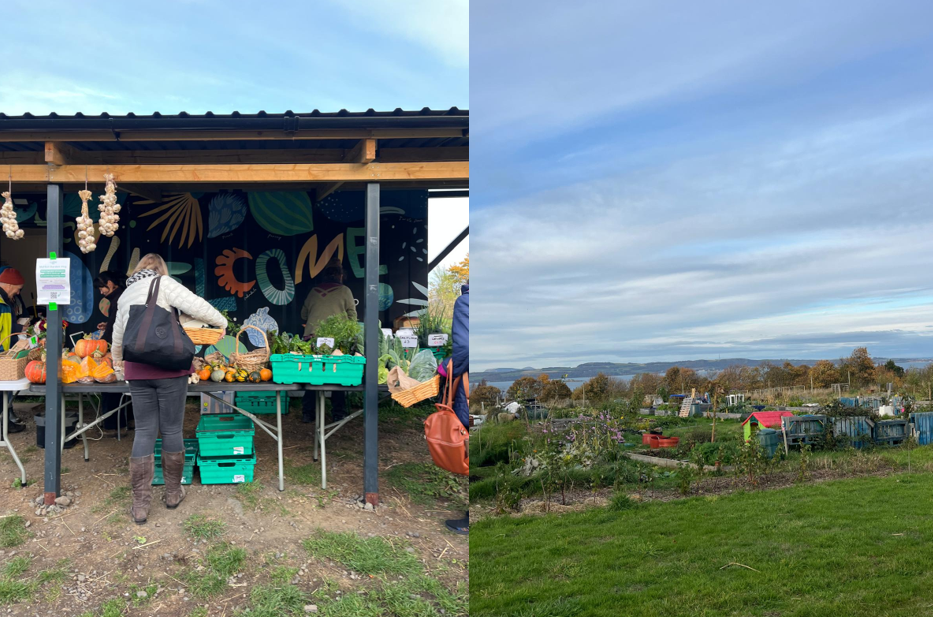
Photos of fruit and veg stall (left) and the market garden (right). Credit: Hugh Wilkinson
In response to the emerging threats posed by climate change, biodiversity collapse and food insecurity, a group of Edinburgh locals have found a way to reverse the damage and produce healthy, affordable foods.
Lauriston Farm is an urban community farming project committed to reimagining how food can be grown in a city. It represents a form of political activism, standing as a quiet but powerful protest against mainstream food production systems. The farm challenges the dominant agricultural model, which often prioritises high yields and profit margins over ecological health. To do this, the people at Lauriston have embraced agroecology, an approach to farming that places community wellbeing and environmental stewardship at its core. Their aim is to provide affordable, nutritious food for local residents, restore and protect local ecosystems, and create opportunities for people to reconnect with the natural world.


Agroecology and Climate Change
The choice to follow agroecological practices at Lauriston has come in response to growing fears about climate change and its impact on food security. The likelihood of a more volatile climate, marked by increasingly frequent extreme weather events, poses a significant challenge to food production. As these climatic instabilities become more prevalent, the sustainability of current approaches to agriculture is becoming more precarious.
One of the main concerns emanating from mainstream industrial farming has been the increased risk of crop failure. Most industrial farms cultivate a single crop variety, known as a monoculture. While this method has long been the norm, it is now proving problematic in the face of unpredictable weather patterns. The rigidity of monocultures makes them particularly vulnerable to climate extremes, which can lead to substantial disruptions in yield and threaten food security moving forward.
Recognising these risks, members at Lauriston Farm have taken steps to maximise the resilience of their food production systems. They achieve this by cultivating a diverse range of crops, which reduces the likelihood of significant yield losses resulting from crop failure. In the video below, Isaac explains how the farm is employing agroecology principles to do this.
In addition to the fears around climate change, the intrinsic sustainability of industrial farming has consistently been called into question. Research indicates that mainstream farming practices are unsustainable because of their detrimental impact on soil health, the resulting air and water pollution, and the significant amount of waste produced.
According to Elise Wach, a researcher at the Institute of Development, “mainstream practices use a lot of chemicals and tend to degrade soils rather than rebuild them which is really catastrophic for water and air pollution.”
She continued: “In contrast, agroecology is about minimising chemical inputs, rebuilding biodiversity and building soils.”
Kate MacDougall, a staff member at the farm, compared how waste production differs between industrial farming and agroecology.
“A staggering amount of food gets dumped before it gets to supermarkets, and then more is thrown out unsold. When people say we need the high yields of industrial farming, they tend not to mention the waste in the system. Re-localised food systems like Lauriston avoid all that waste.”
Despite these issues being widely understood, farmers today still continue to use environmentally damaging industrial farming practices. According to Mrs Wach, the inflated role of the market is to blame.
“The current system revolves around farmers being entrepreneurial. If we are leaving as much as we are to the market, then we’re not producing the right things or in the right way. The government should be supporting everyone to transition to agroecological practices”.

Beneficial to both the community and nature
Aside from the environmental and economic benefits of agroecology, community farming initiatives like Lauriston give people the opportunity to connect with each other and with the environment. For these reasons, Lauriston farm has struck a chord with people across Edinburgh, attracting a remarkably diverse mix of participants. Unlike many traditional allotments, often dominated by older retirees, the farm arm brings together members of all ages and backgrounds. For everyone involved, it offers a welcoming space to meet like‑minded people, spend time outdoors, and enjoy a break from the pace of city life.
In an interview with 25-year-old farm member, Isaac Armstrong, he told us why he comes to the farm.
“I really like coming to the farm because it gives me a sense of community and I can learn a lot of stuff about how to make my own food. I also like to get my hands dirty.”
Another 25 year-old member of the farm, Haroon Usman, added: “I like to work in nature when I can. I live in Edinburgh, which is urban, so it means that I am not really in touch with nature. The farm is a really great place to get out and reconnect.”
The benefits of the farm also extend to local wildlife communities. Staff member Mrs MacDougall said:
“We’re here to make the farm feed local people and more than people. It should be a food source for local wildlife and the more than human world. We’re here to grow food for people and wildlife and bring the farm back to being a much fuller ecosystem”
The map below shows the current projects on the farm.
Next steps for the farm
Looking ahead, Lauriston Farm aims to spread a greater awareness and understanding of agroecology so as to encourage the development of more projects across the country. As part of this mission, the farm has joined up with the UK Land workers alliance movement. Organisations within this movement have the overarching mission of creating a “food and land-use system where everybody, regardless of income, status or background has access to local, healthy, affordable food, fuel and fibre from producers they can trust.”
To help spread the word about their mission, the farm is keen for more people to get involved and runs bi-weekly volunteering sessions on Tuesdays and Thursdays. For more information visit their website here:
Lauriston Farm | Transforming an existing farm into an urban food production and community hub


