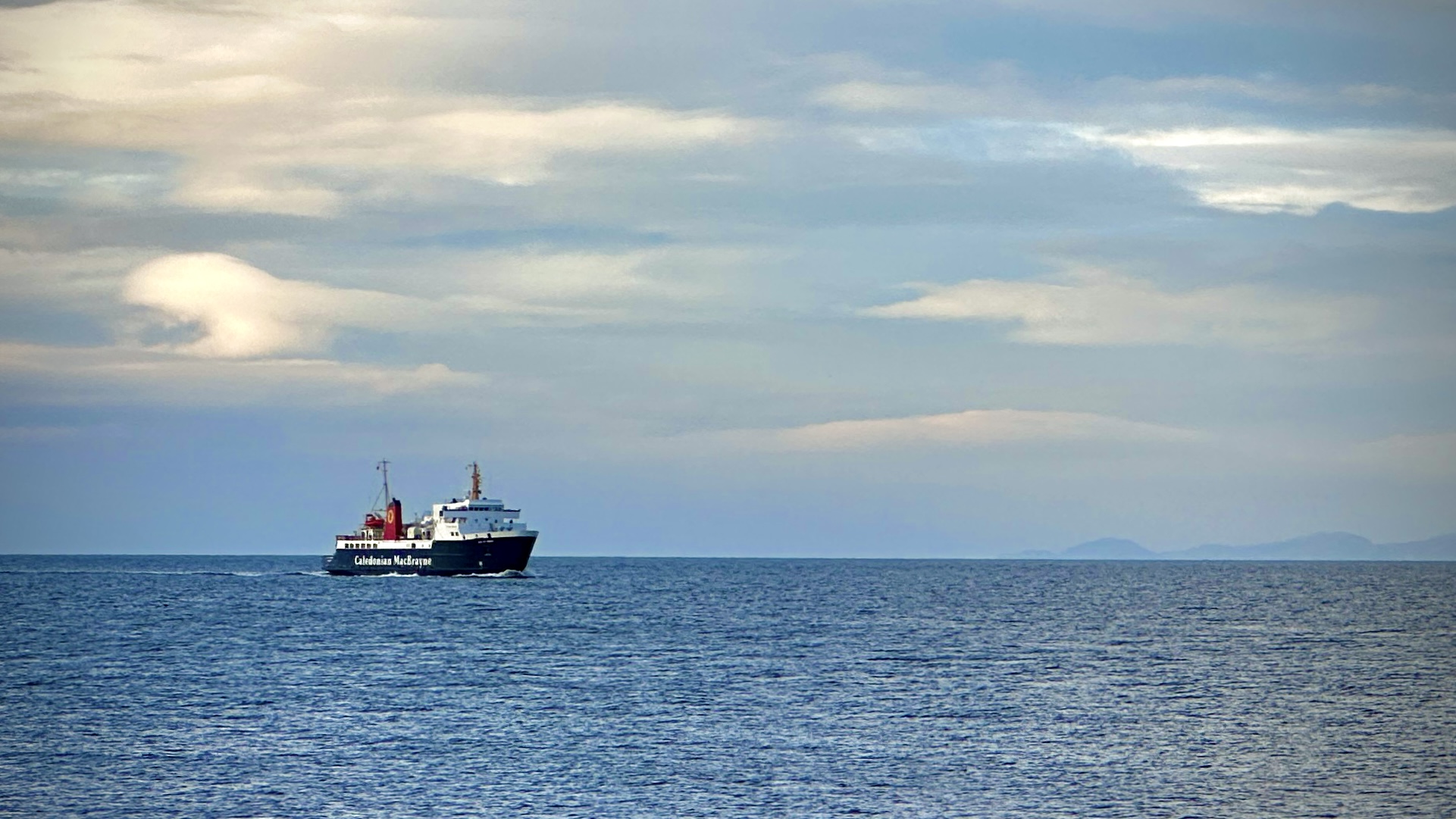
CalMac ferry approaching Troon harbour, Janruary 2026. Credit and copyright, 2006: Gideon Cable
When travelling aboard CalMac ferries this year, why not pass the time by contributing to ORCA scientific surveys by learning to identify and report marine mammal sightings using their app.
Whether it’s the Calmacs along the Clyde and Hebrides or the North Link Ferries to Orkney and the Shetland Islands, at some point when you holiday in Scotland, you’re sure to find yourself on a ferry.
There’s a romance and a thrill to being aboard and seeing the Scottish landscape slide past as you leave port and head towards deeper waters. But what do you do when you move further out and the land becomes a line on the horizon? Read a book? Listen to a podcast? Do your email? It seems a shame to slip back into landlubber habits.
The people from ORCA have a suggestion: be a citizen-scientist and spot marine mammals for important scientific research.
ORCA is a leading marine conservation charity dedicated to the long-term study and protection of whales, dolphins and porpoises and their habitats worldwide.
“What makes us distinct is our focus on giving everyone an opportunity to take an active role in marine science and conversation”, says Lucy Babey, ORCA’s Director of Programmes.
They provide an app where you can learn about whales, dolphins and porpoises and register any sightings from the ferry.

Sue Jarvis is a frequent traveller to the islands of Scotland. “You feel the excitement rippling around the boat when somebody does spot something and everybody loves to see it.”
“There’s nothing quite as beautiful as porpoises and dolphins skipping along the top of the water.”
“It’s a special event every time, but to record the sighting – in the knowledge that what you are doing is part of a survey and that you’re making a contribution that’s valued and has impact- that will be rewarding to me.”
How hard is it to do?
“Anyone can do it if they’ve got the app on the phone”, says Bill Anderson, a volunteer ORCA Marine Mammal Team Leader. “Most of the animals are relatively easy to identify. They have their own ways of moving and all the blows from the whales are all slightly different.”

“Most of the dolphins are fairly easy to recognise unless you just see them at the surface. The worst thing is if you just see an animal just breaking the surface. It could be a bottlenose dolphin, Risso’s dolphin, a common dolphin. It could even be a minke whale because some of the small minke whales are not that huge”
“If you see a minke on the West Coast, in general, all you’ll see is it breaking the surface once, maybe even twice. You don’t get a really good look at it, but you just know from the way it’s moving and its size”
How to get started
The ORCA app is free to download and use. It contains material for you to learn the basics of sea mammal identification and acts as a handy reference at sea. It’s best to download this and get familiar with the animals before getting aboard, Bill suggests. Planning ahead is always a good idea.
You can also look at what marine mammals have been seen on the routes you might take. For the last several years, ORCA has collaborated with CalMac to undertake formal scientific surveys from the bridges of the ferries. Last year, more than 1,500 mammals were seen from the ferries during 37 surveys. The interactive map shows where and when each animal was sighted.
If you want a better chance of properly identifying animals you sight, ORCA also offers training on their website, from a basic Whale and Dolphin Identification through to comprehensive Marine Mammal Surveying course.
Why do it?
“If we don’t look after the wildlife that surround us and we don’t look after the oceans, ultimately, we’re the ones that are going to suffer.”, explains Carol Morris, an ORCA Marine Mammal Surveyor.
“It’s really important to understand what is happening to wildlife because that scientifically can give us a lot of information about what is happening to the world’s oceans.”
“Are they warming? We’re seeing on the West Coast a movement north of some of the bigger whales. Why is that happening? We don’t know. I couldn’t put my hand on my heart and say I know why it’s happening. It could be because the oceans are warming. It could be the food is moving.”
“It all helps to build a picture of the environment. I suppose is what I’m trying to say is that is useful to all of us, whether you’ve got an interest in whales or not.”
“We’re only looking at one very small part of the ocean at a particular time on a particular route. But that all helps to build that bigger picture of what’s happening.”
“There is an attitude amongst people who do this sort of thing that we’re contributing to society. As citizen scientists, we’re getting the data so that somebody who knows much, much more than us can use it and draw conclusions from it.”
Each year ORCA release their State of Cetaceans report which is highly respected and authoritative snapshot of whale and dolphin populations across the world. The data from the formal and casual surveys are contributed to databases accessible to scientists across the globe working not only on cetacean studies, but climate impacts and policy development.
What might you see?
There were 10 different marine species sighted during the 2025 survey. Everything from harbour porpoises to minke whales. There were even two basking sharks spotted and a pod of orca.
But not every journey results in sightings. “I must do 10 or 12 trips a year”, says Bill, “Sightings vary on the route and according to the weather. You might have 30-40 sightings, maybe up to 60 animals. But, then again, you might see nothing”
“If I was doing 10 surveys a year, there’ll be two or three which are disappointing – but it’s data. We want to see things, but having no sightings is still important data”.


