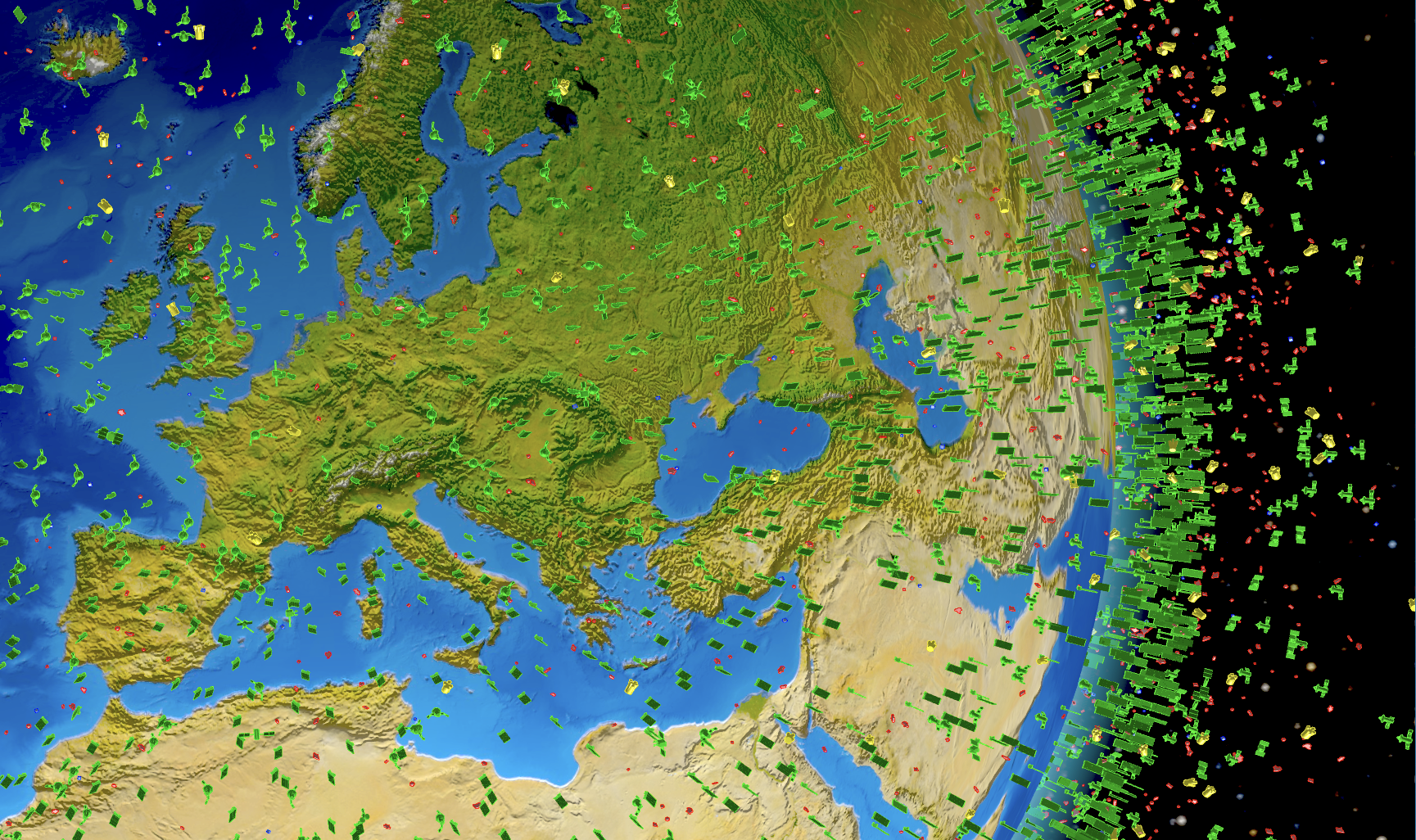
Depiction of real-time positions of Low Earth Orbit satellites by LEOLabs. Captured from their interactive tool. Copyright: LEOLabs, 2025
A North Korean satellite missed a defunct Malaysian satellite by an extremely narrow margin only because the United Nations brokered communications between the nations at the last moment.
The impact of two satellites risks a cascade of collisions that could destroy vital systems we all rely on, such as voice and data networks, navigation, weather observations and geo-imaging.
Speaking on Tuesday, Andrew Marchetti, Government Relations and Communications Officer for the United Nations Office for Outer Space Affairs (UNOOSA), described the incident that occurred around the 21st June this year.
“Normally when two satellites cross each other – let’s say at 5 kilometres – that is considered a risk. So, one would move. But Malaysia said: ‘We can’t move’”
The Malaysian satellite had no remaining fuel so was unable to manoeuvre.
There is no diplomatic channel between the two nations, so it was not possible for Malaysia to warn North Korea of their inability to move their satellite out of the way.
Malaysia contacted UNOOSA to communicate the issue to the National Aerospace Technology Administration (NATA) of North Korea so that they could undertake emergency manoeuvres with their own satellite.
“We picked up the phone to the Chinese embassy in Vienna, where we are based, and tried to reach the North Koreans”
Eventually the message got through and the North Koreans manoeuvred their satellite, narrowly avoiding a collision by only 75 metres.
When passing a cyclist, a car should leave 1.5 metres to be safe. On the same scale, the satellites passed within 2 millimetres of each other.
This was the second incident within six months where UNOOSA had been approached to assist between nations where satellite collisions were imminent. Previously, a close approach of three kilometres was anticipated between a United States satellite and one registered to China.
There is currently no international organisation responsible for space traffic monitoring and co-ordination.
Orbit becoming dangerously ‘overcrowded’
Mr. Marchetti was speaking on a panel before the Scottish premiere of Fortitude, a documentary about the commercial space industry, at the Glasgow Science Centre. The event coincided with the biggest space industry event ever held in the country, Space-Comm Expo Scotland. More than 2,300 delegates, 100 speakers and 80 exhibitors attended the conference at Glasgow’s SEC campus on the 3rd and 4th December.

Since 2015, as a result of miniaturisation, commercial space operations have launched thousands of pieces of equipment into orbit. The majority are in Low Earth orbit (LEO) such as constellations of micro-satellites for data communications and navigation.
Over 25,000 items were launched into space during the last 5 years. That is more than 50% of all items ever launched since the first artificial satellite, Sputnik, in 1957.

Copyright: European Space Agency (ESA), 2025. Source: ESA Space Environment Report, Oct 2025
Starlink, Elon Musk’s LEO constellation of around 10,000 satellites providing internet service, had to make over 144,404 collision avoidance corrections in the first six months of this year according to analysis of a submission to the Federal Communications Commission (FCC) in July. That’s more than one satellite manoeuvring every two minutes. This is an increase in the number of avoidance manoeuvres per satellite in comparison to previous reporting periods.
Additionally, the submission identifies 54 times where the avoidance manoeuvres were unable to be executed effectively. 42 were because the information identifying a possible collision did not reach the control systems in time. Two cases were due to ‘“non-cooperative maneuvers[sic]” from [other] operators’, implying there were disagreements between satellite operators about how to avoid collision.
In a report released in October 2025, the European Space Agency (ESA) emphasised Earth’s orbital environment is a finite resource which is becoming overcrowded. To quantify sustainability of the environment they define a risk index and an acceptable threshold to ensure systems relying on satellites will continue to work.
It currently estimates the risk is four times higher than is acceptable and there are likely to be 50 catastrophic collisions in the next 25 years unless behaviours changes.
Speaking just after the incident in June at the 68th session of the Committee on the Peaceful Uses of Outer Space, Aaati Holla-Maini, Director of UNOOSA, said: “UNOOSA is not a hotline for Space Traffic Coordination. This is a responsibility that this Committee must assume. We urgently need an International Committee for Space Traffic Coordination.”


