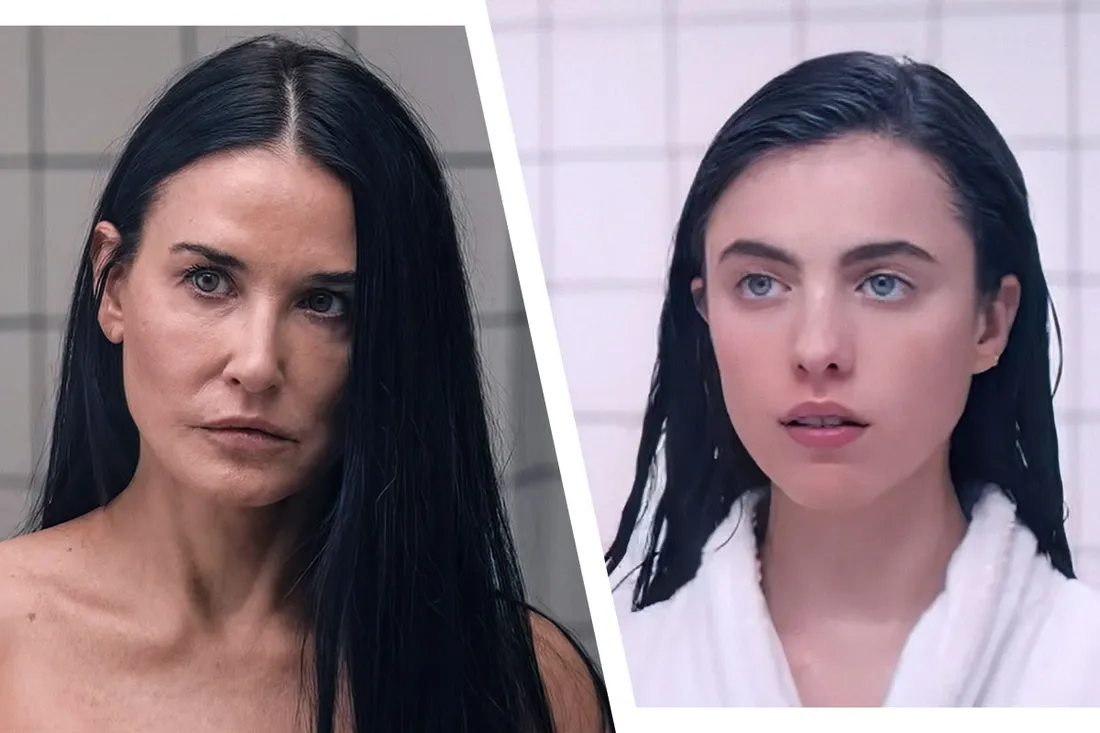
Natasha Singh, an aesthetician tells us about the ins and outs of altering our appearances and to enhance our natural features. In comparison to “The Substance” a film about the lengths people will go to preserve their youth.
‘The Substance’ presents a blend of sci-fi and body horror, filled with visually striking, if unpleasant, imagery. The opening shot takes us to the Hollywood Walk of Fame and from there, are taken onto the journey of main character’s rise to fame and her identity that is deeply intertwined her career. On the centrepiece of the star lays the name “Elizabeth Sparkle”, it is built from the ground up till it becomes cemented into the ground and shines with brilliance till she is a star.
The name suggests that there are pieces to the story that are yet to unfold and are deeper within her fame, hinting towards something darker. Perhaps, the name could be a metaphor for something relative to her celebrity status. Elizabeth Sparkle, portrayed by Demi Moore, is an acrobatic instructor along with a team. Everyone adores her and all is well, till her own sparkle fades. Overhearing a conversation between her producer and an assistant that castings are underway to replace Sparkle leading her to catastrophic measures to keep her fame intact.
Her car accident sparks the introduction to ‘The Substance’. An assistant nurse at a hospital slips a note inside her jacket with a note which reads “It changed my life”. In her pocket she finds a yellow filled “substance” in a tube with a needle. Initially, Sparkle was hesitant to the idea, but this changed rapidly. After her producer abruptly gives her belongings from the set and urges her that everyone “inevitably [is] looking for something and at 50, well it stops”. She was no longer the Elizabeth Sparkle everyone knew. Plus, she was no longer employed and left to fend for herself. A grotesque scene of the transformation to her “better self” where ‘Sue’ played by Margaret Qualley crawls out of her and must inject her with food for next seven days. But how far can we go to change our exterior?
In light of what was seen here, Natasha Singh, from Bareface Aesthetics, tells us more about the ins and outs of altering our appearances from the perspective of an aesthetician. Her page “Bareface Aesthetics” is where she showcases her client’s before and after transformations and engaging videos. She specialises in dermal fillers, anti-aging treatments and fat dissolving. Natasha points to how she balances enhancing a client’s natural beauty and altering their appearance “choosing treatments that complement their face”. “The Substance” at first does the same” going for small tweaks at a time can help them achieve the results they are looking for without overdoing it”. However, Sparkle’s behaviour gets uncontrollable once she comes to terms of the power of what the injection is capable of. Natasha admits that “if [clients] come in for treatment that they generally don’t need, I will refuse, as we can get a bit ahead of ourselves thinking what we can change next”. Sparkle’s determination to keep living out her dreams stopped her from thinking rationally about altering her appearance, and there was no such person to guide her into eventually stopping the injections. Consultation appointments are essential to Natasha, for two reasons-being able to know whether a person wants to change something they are insecure about or if they are following their friends in the trend of a treatment. It is important to gauge the reasoning behind their wishes for the treatment. But not everyone’s the same and in her opinion, “one treatment could work wonders for one client and the same treatment maybe not for another”.
In the age of social media, we often compare ourselves to the many lives we see as we scroll by, forgetting that their own lives are also not perfect. It is everyone’s highlight reel. Natasha explains that due to social media’s presence in decision making when it comes to altering one’s life, “it can also maybe make clients feel like they are flawed in certain aspects- because of them seeing unrealistic posts on social media”. So, in her practice, comes down to “reminding them that it can mess with [their] heads” seeing so many individuals online that also do not portray their true selves on their accounts. Because of this, making smaller tweaks to a client’s appearance is much easier, because “for them to come back in and have top ups than filling them up, as opposed to regretting getting so much and wanting to dissolve”. According to Natasha, treatments are only supposed to enhance the natural you, some clients have been put on a ‘filler ban’, if they are making too many appointments in shorter amounts of time.
The Substance’s messaging highlights the lengths a person would go, to preserve their youth. When going in for a treatment, two most important aspects are to “getting a feel for the person you are trusting to be your injector”. Also, making sure that “yourself and the injector are clear on every aspect of the treatment you are hoping for”. Most important of all to Natasha is that “clients should be kinder to themselves”, it makes her “burst with pride’ knowing she has heightened someone’s self-esteem because of a treatment she has done for them. However, The Substance shows what can happen when a person goes too far to change their appearance and how it can impact one’s wellbeing. Changing our exterior to a certain measure can make us feel better about ourselves, while enhancing our natural features that make us who we are. But, it is clear that we must proceed with caution or, just as was the case for Elizabeth Sparkle, things can get out of hand.


