Catriona Harrison discusses ethical boundaries and individual stories with award winning photojournalist Lalage Snow.
“It’s really easy to photograph war,” award winning photojournalist Lalage Snow remarks, “it’s really photogenic, but for the people who live there, it is pretty monotonous, and it is just life as it is.”
Having spent seven years of her career covering war and unrest in the Middle East and Afghanistan, Lalage Snow has dedicated her career to giving a voice to those often left unheard. Through the lens of her camera, she aims to uncover the individuals living through war and conflict, claiming that “I always try to tell the story through other people, from their perspective and that has always been my driver.”
“People are the story, the individual.”
Lalage’s first foray into photography was through a club at school where she enjoyed the process of film development, “putting the negative into the carriage and seeing it appear”. Worlds away from the conflict zone of Afghanistan, Lalage remembers she was, “quite timid, not shy, about putting my camera in front of people’s faces”, and would photograph still life, “focusing on details, I suppose, that I found curious or beautiful.”
It was only when Lalage was living and working in the Middle East, as a writer that she “started to hone in on how to take pictures of people by just meeting other photographers”. Now in a high-octane environment, miles from her school photography club, Lalage’s goal was still the same,
“I very much focused and filtered through my camera, so if I was looking at something horrific, I was trying to make it into a beautiful image”.
Brought up in a military family with a brother in the army, Lalage remarks that her upbringing might have “lent itself well to being able to understand the military and then start photographing conflict from that side, and then later having the confidence to shift to having a much broader appreciation of conflict”. Her first time photographing a warzone was with her father and brother’s old regiment in 2006.
“You don’t do this job if you don’t have a certain strength of character”, she remarks, “you are driven by a passion and determination to tell other people’s stories”. By focusing on the individual in war, Lalage enables the viewer of her images the ability to connect to the subject on a personal level.
Recounting a famous quote from Stalin, “a single death is a tragedy, a million deaths are a statistic”, Lalage discusses our desensitisation from war, “people don’t know what war is until they’re in it”. She continues, “it is really glamorised and glorified in films”.
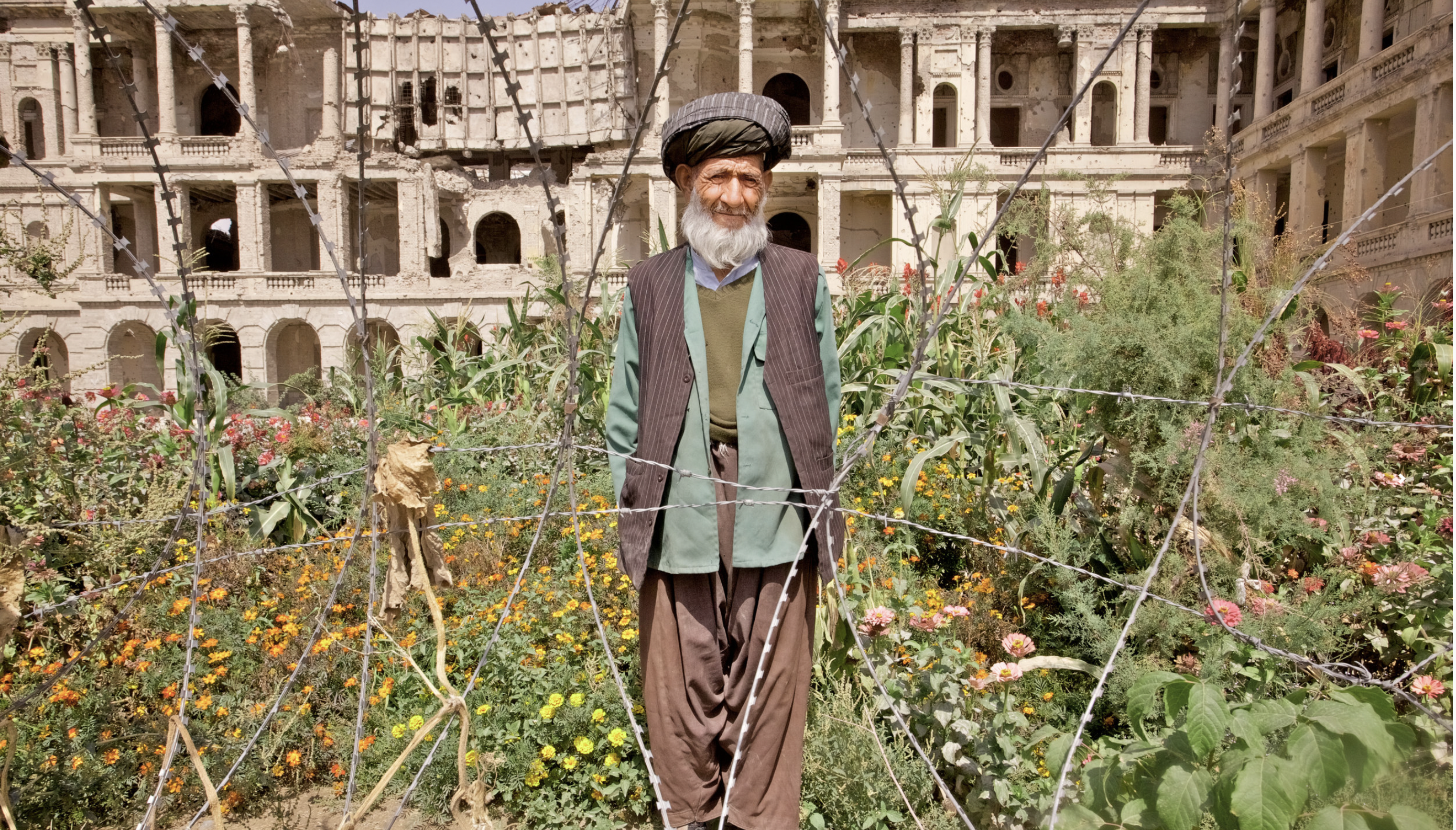
Finding the individual in conflict was Lalage’s main incentive when writing War Gardens, a book that documents the stories of people living in conflict zones. From Afghanistan and Iraq to Ukraine and South Sudan, Lalage used the idea of the ‘garden’ as a way of looking for a regeneration of life when existing through conflict, “anything green.” She continues,
“I took the word ‘garden’ really broadly to mean a garden as you and I might know it, to be a flowerpot with a seed growing in it, to be an orchid, a single plant in a single scrubby bit of field. It was just the idea of growing”.
The pictures that accompany the words show people standing next to their ‘garden’ whatever that may be. In one picture there is a man standing in front of a colourful garden, full of orange, yellow and pink flowers; in the background, there is a destroyed building showing signs of once grandeur, he appears encased in a barbed wire.
“I wanted to try and reinvent the way we tell stories of conflict to try and turn it on its head, I chose the exact opposite of war to tell the story and that was a garden, growth… anything that was not dying.”

In an article written by Women’s Media Center, ‘Women Under Siege’, they write, “While gender itself doesn’t determine the photographs a person takes, it can influence her access to scenes and people and shape the photographs that circulate as a result”. This is corroborated by a study that focuses on female photographers in Australia that found that “Codes of behaviour dictated a male stoicism in the face of traumatic assignments, such as car accidents and police rounds”.
Lalage recounts working in countries where women are second class citizens and making sure you stay safe in a warzone was no easy feat, “dress accordingly, act accordingly… personal care, making sure you wash… that could be annoying”. However, she continues, “on a psychological level, you become quite immune to it after a while”. Lalage lived and worked in conflict zones for seven years, living through the horrors of conflict, potentially becoming the individual living through the mundanity of war.
Living in Kabul for five years and documenting the ongoing conflict in Afghanistan, Lalage recalls, “the first time you’re in a really high-octane environment, it comes as a real shock. I think the first time that happened to me was in a riot in Dahkar, in Bangladesh… there was tear gas and rubber bullets.”
However, through all the difficulties of being a woman and being a photojournalist working in conflict zones, there is a reason why people as strong as Lalage do the job they do, to tell the stories of the individuals. She discusses the motivation for putting herself on the front line repeatedly, “You are driven by a passion and determination to tell other people’s stories.”
“Sometimes when you see these bad things and the sense of injustice, you feel the drive to keep telling these stories… it is very much a personal thing, it is empathy I suppose.
It gives you determination to carry on doing what you’re doing so that things can change for people.”

Without people like her, we turn to film and TV, seeing the horrors of war on our screen, which potentially glamorise the conflict with star studded casts to boot. The personal ethical boundary when focusing on war is important, where is the line? When does suffering cease to make a ‘good picture’?
Leslie Jamison writes of the ethical quandaries faced in situations where the photographer is photographing people suffering, or even just living. She asks the question,
“What does it mean to make art from other people’s lives? What distinguishes exploitation from witnessing, and when is that witnessing complete? Is it ever?”
Lalage discusses her personal ethical boundary, “for me, when photographing war and conflict, if there is an individual who is dying that I can help, I will help them because that is my job”. She continues, “which conflicts with the work of journalism as you are the messenger, not the saviour”.
“I value life more than I value a story.”
Lalage remarks, “it’s up to you as a journalist to tell other people’s stories”.
It would appear the ethical boundary when photographing and reporting is personal, but for Lalage her role in these conflict zones is to save lives, if not through her work as a photojournalist, then as a human.
Photographing and documenting conflict is as important as ever, even with cameras at our fingertips, Lalage discusses, “the challenge is to be authentic and to take good photographs and to find the correct platform where they can be correctly and honestly and well portrayed”.
Upon asking Lalage how she continued to stay strong when reporting from the front line, she replied,
“Sometimes it wasn’t possible to be strong and that was also okay. The good thing about working and living in a place is that you’re surrounded by friends doing the same thing and you have a camaraderie of people behind who can support and understand in a way that perhaps people or friends at home may not be able to fathom.”


