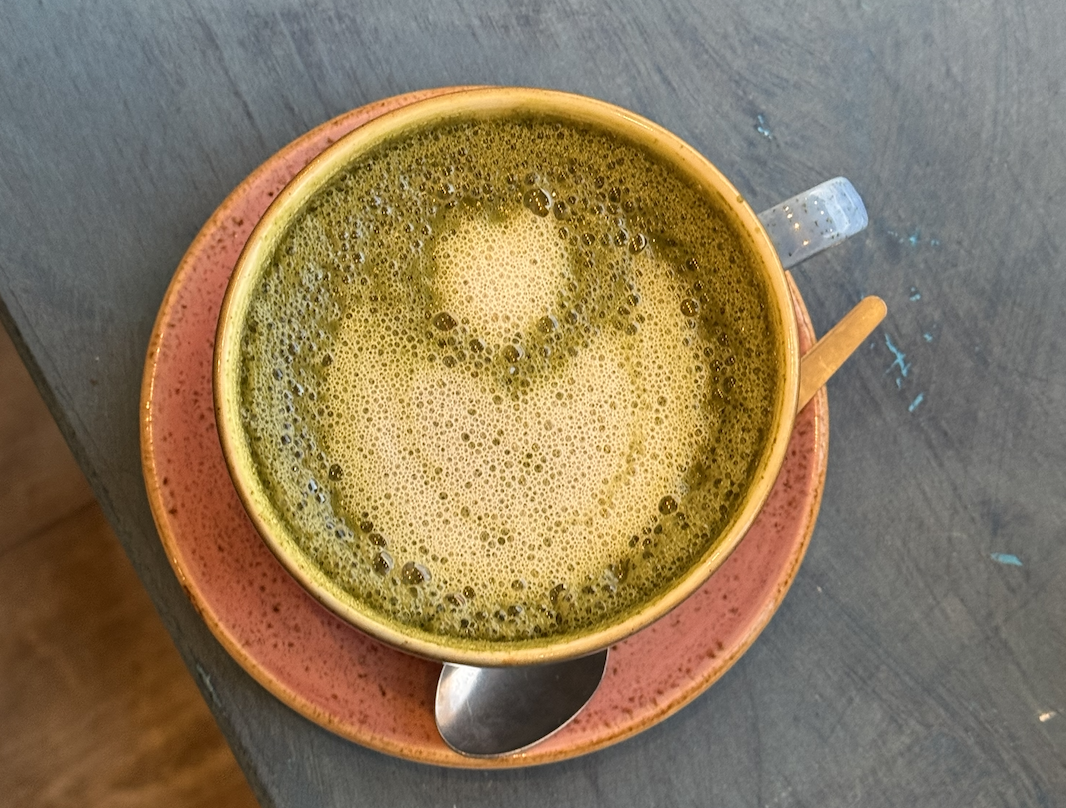
In conversation with Adele McPhee, owner of Willow Grove Café and Martin Fell, owner of Tchai-Ovna Fine Teas, about matcha and whether they think matcha belongs in our Western culture.
Matcha, a green beverage made from shaded green tea leaves that originates from the Tang Dynasty (7th-10th century). The drink that is a cultural symbol of the Asian culture has now been altered to suit our Western culture. Traditionally, matcha was served with hot water, without the current additions of plant-based milks, additional spices, or a frothed strawberry foam. Do the new additions reflect our appreciation for matcha, or are we adopting matcha to suit our tastes?
History of Matcha: From the 7th Century to Now
During the Tang Dynasty, the leaves of matcha were roasted and reduced to a smoother powder. At this time, matcha was formed into bricks and transported. This changed during the Song Dynasty (10th-13th century), when matcha became popular thanks to a Japanese Buddhist monk. The monk, Myoan Eisai, was studying Buddhism in China, and in 1191, he returned to Japan and brought along tea seeds that he planted in Kyoto. The Zen Buddhist developed the method to grow the plant in shaded conditions, which expanded matcha’s health benefits.
The benefits of matcha were discovered through Japanese tea ceremonies known as “chado,” meaning “the way of tea.”. Matcha during this time was also largely a part of meditation practices. During regular temple rituals, a bowl of the beverage was offered as a sacrifice to Buddha and was also known to attain enlightenment. The tea itself during the ceremonies was defined as peace (jaku), purity (sei), respect (kei), and harmony (wa). Nowadays, the ceremonies continue and show a deep appreciation for the continuity of tradition and the opportunity to meet a like-minded individual.
The Beginnings of Willow Grove Café and Tchai-ovna Fine Teas
Willow Grove Café and Tchai-ovna Fine Teas beginnings in the world of matcha began very differently. The owner of Willow Grove Café, Adele McPhee, wanted to bring to Scotland a piece of her travels from Australia. She envisioned the café in her head since the age of 20. When Adele arrived back in Glasgow, she realised there were not a huge number of cafés in the city. This sparked the idea to make her imagination come true in Glasgow’s West End. Her personality shines through the décor, with coloured posters she has collected over the years. Adele points out that “I have quite a cluttered brain. So, this is it stripped back as much as possible”. She says that as much as she likes minimal cafés, that was not her vision for Willow Grove. An opportunity fell into her hands during Covid, when a customer of hers, who was the director of Scottish Opera, gave Adele and her team “first dibs” on a café. It was already established within the building, but it was no longer running. Adele explains the experience as “fight hard or go home. Just give it a shot. What’s the worst that could happen? And it paid off-So that’s on its fourth year now”.
Tchai-ovna Fine Teas, owner Martin Fell’s stay in the Czech Republic, when he was a 19-year-old, gave him a sense of understanding of tearoom called “čajovna” in Czech that seemed to bring a balance into people’s lives. After his trip from the heart of Europe, he came to Glasgow, which he says in his own words that Glasgow “was too [much of] alcohol culture, did my head in; there was nothing that I found that was like that, so I had to start it myself.”. The tearoom opened in the early 2000s, and its priority since has been to remain as authentic to the original matcha as possible. Martin finds the alcohol culture in Scotland quite “hedonistic,” whereas in the Czech Republic, even though you drink beer all day, it is not quite to the same measure as in Scotland.

Matcha Suppliers and the Benefits of Matcha
Blendsmiths, a matcha supplier for Willow Grove café, is a small business that was started by Chris and Ryan in the UK. They are known not only for their matcha but also their beetroot and turmeric lattes. Their matcha has various blends of spices and flavours that take a more Westernised approach to matcha. Tchai-ovna’s suppliers are growers from the South of Japan in Kagoshima. Martin highlights that “Matcha really is a tea that comes from shincha, which is high-grade leaf green tea, which is powdered down, so that’s ceremonial matcha”. What we find in our milkshakes is a very low-quality matcha that Martin deems is not up to the standard of the true matcha.
The difference is how we enjoy our matcha in the east and the west. A staff member from “How Matcha,” a matcha business in London, says in the east, it is enjoyed with “water and thicker,” meanwhile in the west, we enjoy it “slightly less strong”. There are many benefits to it over coffee. A caffeine boost from coffee lasts 2-3 hours, and matcha’s boost lasts over 6 hours.

Does Matcha really belong to our western culture?
To answer the question, is the fact that we have adopted a cultural symbol for then Asian culture over centuries a good thing? Willow Grove Café and Tchai-ovna agree that it is a good addition to our culture. Adele says that “mixing different cultures, as long as you don’t abuse it or totally rip it to shreds, I think it’s nice for. People to taste and try everything”.Martin says that we in the West tend to “ borrow ideas from elsewhere—then makes it not as good as the places we got it from”. According to Martin, matcha, being a tea, will never disappear. As always, people have always drunk tea, which can never go out of fashion.


