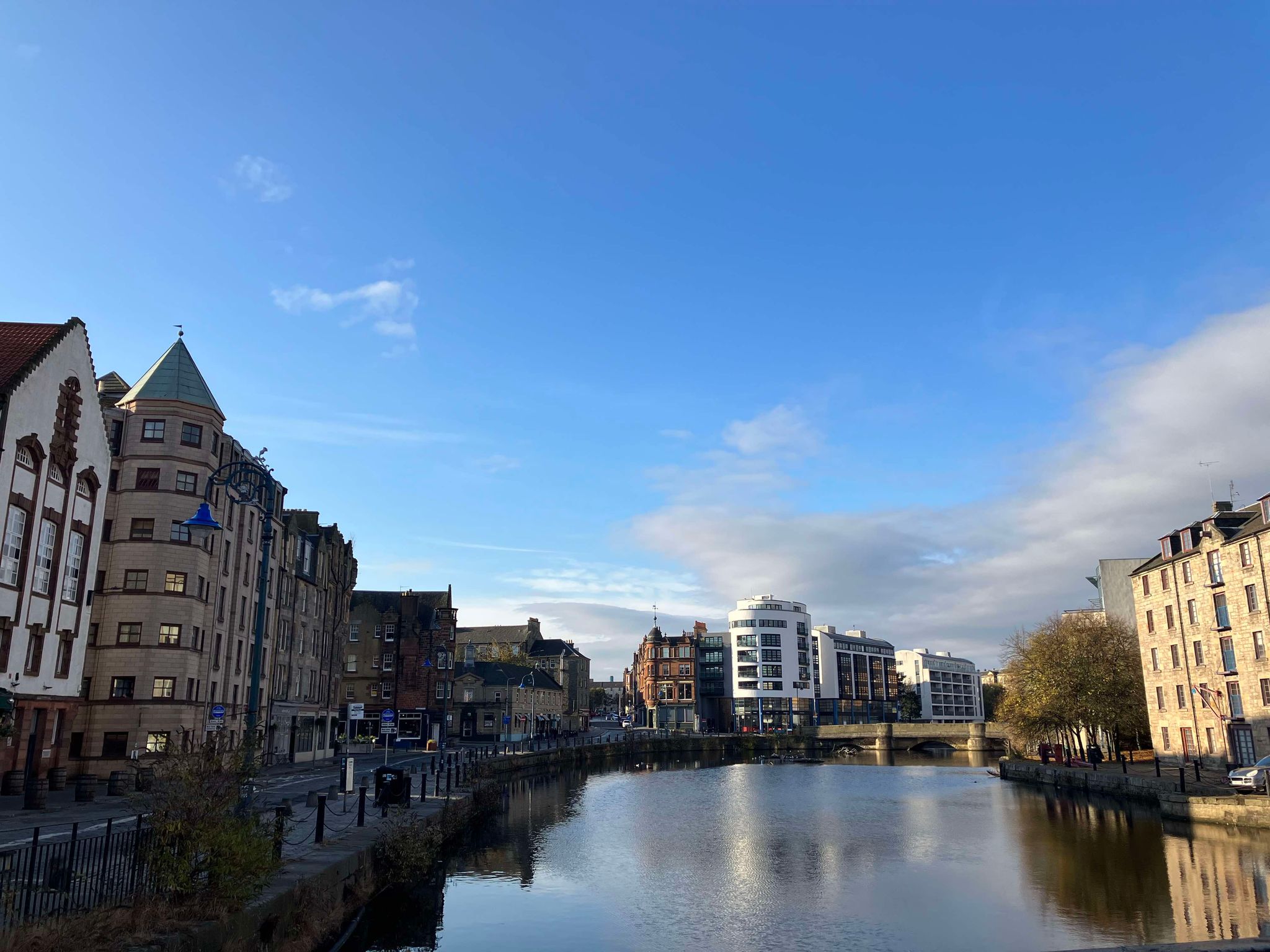
One year after the Shore was crowned the best neighbourhood in the UK and Ireland, Fiona speaks with local pub owners, managers and staff about their take on how Leith in Edinburgh has changed, the concept of ‘gentrification’, and how local pubs can enhance people’s lives.
In 2023, the Shore in Leith was voted the best neighbourhood in the UK and Ireland at the Urbanism Awards. In recent years, it has gained growing numbers of new small-plate restaurants, wine bars, and artisan cafes. In stark contrast to the newer pursuits, the area is also home to some very historic drinking holes that have been at the heart of its community for many years.
The King’s Wark

Iain, the owner of The King’s Wark – just down by the shore – tells me that their “building has been there since 1434”, however, “It’s been an actual pub for about 100 years. When royalty came to the docks, it was where the men from the boats would come – somewhere to get off the water for the night.”
Iain has lived in Leith for 24 years. During that time, he says that he’s seen “a lot of places popping up that would have suited the younger population, but they’ve come and gone.”
At their pub, the demographic has definitely changed. “We’re usually more of a 45+ age bracket, but we now have a lot more youngsters coming into the pub,” he tells me. “It’s definitely helped trade.” The King’s Wark leases from Star Pubs & Bars. “I signed the lease five years ago and my rent is going up, but that was all structured in the lease anyway. ‘Gentrification’ hasn’t affected my rent, but from speaking to folks in other businesses, I do know folk who’ve had to give up businesses because the rent has gotten too high.”
Malt & Hops

Just down the road, I speak to Calum, proprietor at Malt & Hops. I ask about his take on ‘gentrification’ and its impact on Leith. “Well, I used to carry a dictionary about when I was at school so that I would know things.” He brings out two dictionaries from 1976 and 1992 and passes me one.
“I always liked to know what words meant. And they do make mention under gentry. There’s no word such as ‘gentrification’ in the dictionary back then. This is a concise dictionary – but it’s not the complete dictionary. And it doesn’t talk about people coming into an area and pricing you out. That’s a very modern concept. It talks about a class of people just below nobility. It’s very much a status thing, very much a class-related term, landed gentry. People coming in and buying up property would be an extension of that.”
Calum continues, “I do have my slight reservations about the term. It’s just because, in the 80s, there was a sort of cultural change to almost like an anti-snobbery. But I’m not sure it was real snobbery. I should point out; I don’t consider myself one of the landed gentry or anywhere near it. I do have a house – I bought a house in the early 90s.”
We discuss the social change that Calum has noticed in Leith. “I’ve seen it since 1993. Back then I would’ve seen a lot more roughness in the area, a lot more violence, sexism. In the area, a lot of the pubs had strippers, but when I took on the pub in 2006, they changed the leases around about then as part of the Shore Regeneration Project in the 80s. But I think a lot of the social change has to do with people’s choices.”
The Bowlers Rest

A few streets over, you’ll find The Bowlers Rest. Carole has been at the pub since 1992. “My dad owned it,” she tells me. “And before that, it was Laurie Riley. He had it for 36 years, I think. And then my dad bought it off him in October 1992.”
“When we first came here, the bonded warehouses were still working,” she continues. A good percentage of our customers, apart from locals, came from the bond, they were bond workers, so they worked in the whisky bond industry, and they used this as their local. You could have 40 locals and 50 people from the bond here on a Friday night. Even during the day. When they finished up after work, they would just kind of come in here.”
“There are people who still come here that came when we first opened. I have known them that long. They’ve been my friends that long and they’ve come in with their children, their wives, so we’ve seen babies grow into our customers now.”
Carole gestures to the gold plaques around the room. “We have little plaques on our bar. Some of the punters that we’ve had over the years, that’s just a memorial for them. The places they used to sit, stand – that kind of thing. Because they meant so much to so many people.”
We talk about how Covid-19 impacted the pub. Since then, Carole says, “I still do table service for some people because they Iike it. And it does make a difference.” She shares, “You have to be there for them [the customers], because they want a reason to keep going and I think that’s what a pub provides as well.”
I ask Carole how Leith has changed over the years. “It’s definitely got wealthier,” she reveals, “there’s no doubt about that. Obviously, the bonded warehouse is closed. People had to go and get other work so that would affect us as well.”
“It’s kind of as though you are custodians.” She continues, “I know it sounds a bit crazy. It’s an ever-evolving kind of situation with people and you have to kind of evolve with them.”
Ceceley, the new owner, took over two years ago. “Although we still have that community, there are a lot of different customers,” Carole says.
Ceceley tells me, “My background was in chaplaincy and community and fundraising, non-profit fundraising and healthcare and taking care of people. On my card, it says ‘chaplain’, it’s an extenuation of the work that I did. This is what it means to be a member of the community, and not just a business trying to make money. I want this to be a place [where] people who live and work [in the area] can feel comfortable.”
The Bullfinch

Ralph is one of the owners of The Bullfinch, previously known as The Pond, a newer pub that celebrates its traditional roots. “We’ve been here for three years; it’s a purpose-built pub. It was a dockers’ bar because that road there is kind of road to nowhere – it just goes straight to the ships,” Ralph indicates to Salamander Street. “It was all industry. This was nothing but warehouses.”
“This was also the last active red-light district, apart from Amsterdam. Mid-90s when I was at school, this was still a functioning red-light district.”
Despite the change, Ralph says that some regulars who would drink in The Pond, “probably about 6 to 10 people,” still drop by weekly.
“We’re a free house, so that’s a massive deal. We pride ourselves on serving independently, locally sourced and worldwide craft beer and we’re owned by Barney’s Beer. We’re Edinburgh-based, independent, and owned by an independent brewery.”
Despite the growth in Leith, the future remains tough for businesses and only time will tell what happens next. Ralph says, “I’ve done this for 20 years now. Hospitality is the most unpredictable thing in the world. You just don’t know. But we’ve gone into this venture with the vision to see it through.”
“We’re still really young. But it’s tough, waking up every day, going on social media or reading the paper or whatever, and it’s just like, this place is closing, that place is closing, and it’s just so tough. And the pressures that are put on these people to make it work is just nuts, but it doesn’t stop people from constantly opening up new places.”
You can stay updated with news from all of the pubs featured in the article by following them on social media. And if you’re in the area, make sure to pop by for a drink.
The King’s Wark, Facebook, Instagram
Malt & Hops, Facebook
The Bowlers Rest, https://bowlersrest.com/, Facebook, Instagram
The Bullfinch, https://www.thebullfinch.co.uk/, Facebook, Instagram


